
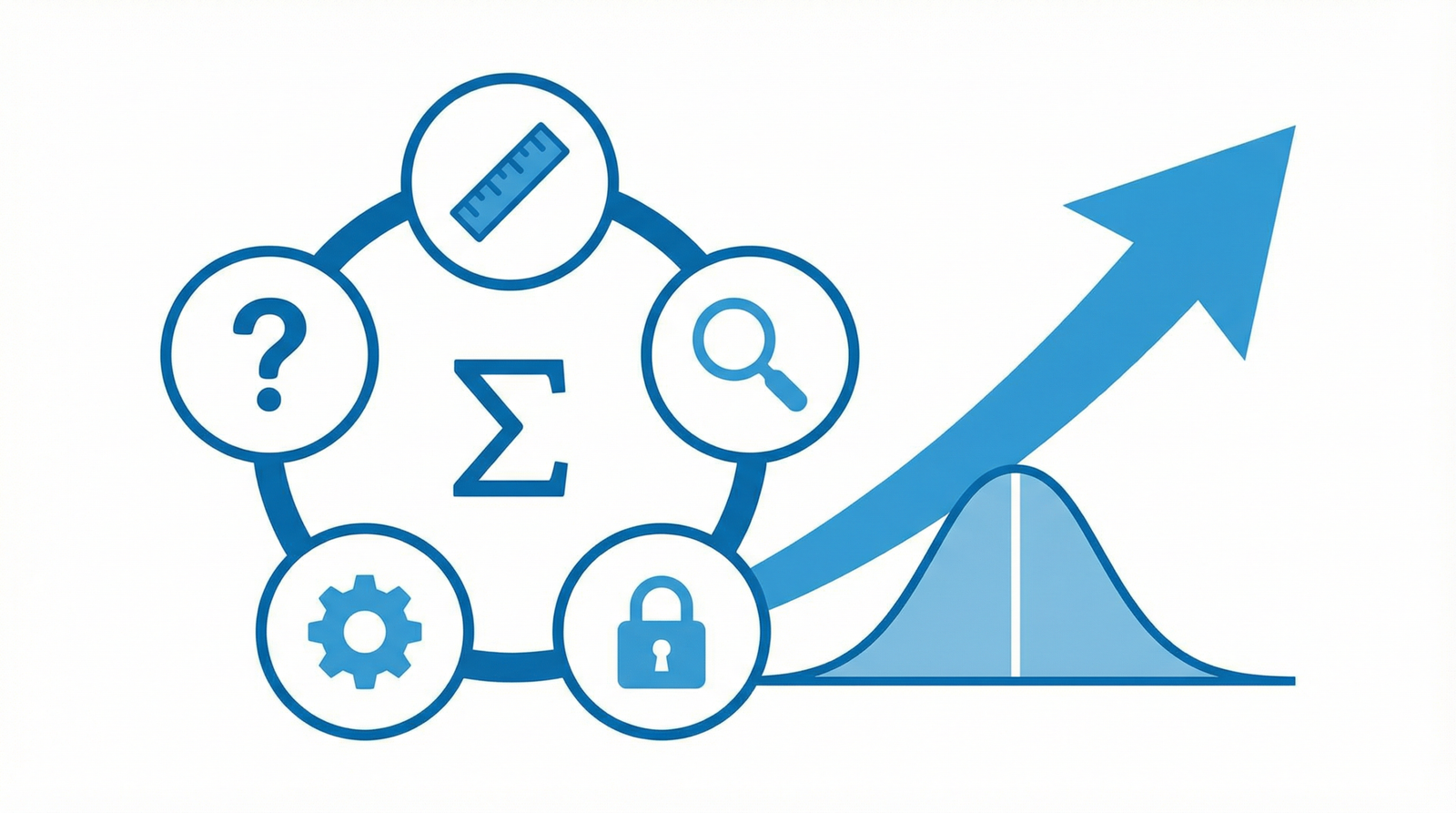
Six Sigma is a powerful data-driven methodology that helps organizations eliminate defects, reduce process variation, and deliver consistent quality. Since its development at Motorola in 1986, this methodology has saved companies billions of dollars and transformed industries from manufacturing to healthcare, finance, and technology.
If you’re asking what is Six Sigma for the first time, this comprehensive guide explains everything you need to know. We cover the core methodology, belt certification levels, essential tools, real-world applications, and how to get started on your improvement journey in 2026.
Understanding what is Six Sigma opens doors to career advancement, organizational improvement, and measurable business results. Quality professionals who master this methodology consistently rank among the highest-paid and most sought-after in their industries.
What is Six Sigma? The Definition
So what is Six Sigma exactly? It is a disciplined, data-driven approach for eliminating defects in any process. The term refers to a statistical concept where a process produces no more than 3.4 defects per million opportunities (DPMO), representing near-perfect quality.
The name comes from statistics: sigma (σ) represents standard deviation, measuring how much variation exists in a process. A process performing at the six sigma level has six standard deviations between the process mean and the nearest specification limit.
This leaves virtually no room for defects, which is what is Six Sigma’s ultimate goal for every organization.
Performance Levels Explained
| Sigma Level | Defects Per Million | Yield (%) | Real-World Example |
|---|---|---|---|
| 1 Sigma | 691,462 | 30.9% | Unacceptable in any industry |
| 2 Sigma | 308,538 | 69.1% | Many startup processes |
| 3 Sigma | 66,807 | 93.3% | Average company performance |
| 4 Sigma | 6,210 | 99.4% | Good quality level |
| 5 Sigma | 233 | 99.98% | Very high quality |
| 6 Sigma | 3.4 | 99.9997% | World-class excellence |
To put this in perspective: at 3 Sigma accuracy, a hospital pharmacy would dispense 54,000 wrong prescriptions per year.
At the six sigma level, that number drops to just 12. This dramatic difference illustrates why understanding what is Six Sigma matters for every organization.
The History Behind the Methodology
Understanding what is Six Sigma requires knowing its origins and how it evolved into a global business strategy.
1986: Birth at Motorola
Engineer Bill Smith at Motorola developed this methodology in response to growing quality problems and Japanese competition.
Smith recognized that reducing variation in manufacturing processes would dramatically reduce defects and costs. Motorola CEO Bob Galvin championed the approach company-wide.
The results were remarkable: Motorola saved $16 billion over 11 years, proving what is Six Sigma capable of delivering.
1995: General Electric Transformation
CEO Jack Welch adopted the methodology at General Electric, transforming it from a quality program into a comprehensive business strategy.
Welch required every executive and manager to complete training, making it the foundation of GE’s management culture.
GE reported $12 billion in savings during the first five years, demonstrating what is Six Sigma’s potential at enterprise scale.
2000s: Global Expansion
Companies worldwide adopted the methodology across every industry. Healthcare, financial services, government, and technology organizations discovered that what is Six Sigma offers applies universally to any process generating measurable outputs.
2010s-Present: Lean Integration
Modern practitioners increasingly combine statistical rigor with Lean manufacturing’s waste elimination principles.
This integrated approach, known as Lean Six Sigma, delivers faster results by addressing both variation and waste simultaneously. The foundations of Lean methodology trace back to pioneers like Shigeo Shingo and the Toyota Production System.
The DMAIC Methodology: Heart of What is Six Sigma
To truly understand what is Six Sigma, you must master DMAIC — the core methodology that drives every improvement project. DMAIC stands for Define, Measure, Analyze, Improve, and Control.
Phase 1: Define
Purpose: Clearly identify the problem, project scope, and expected business impact.
Key Activities:
- Write problem statement defining the issue clearly and specifically
- Create project charter documenting scope, goals, timeline, and team
- Identify customers and determine Critical to Quality (CTQ) requirements
- Map high-level process using SIPOC diagram
- Calculate potential financial impact to justify project investment
Key Tools: Project Charter, Voice of Customer (VOC), SIPOC Diagram, Stakeholder Analysis
Phase 2: Measure
Purpose: Quantify current process performance establishing a reliable baseline.
Key Activities:
- Identify key process input and output variables
- Develop data collection plan specifying what, how, when, and who
- Validate measurement system accuracy and reliability (MSA)
- Collect baseline data representing current performance
- Calculate current process capability and sigma level
Key Tools: Data Collection Plans, Measurement System Analysis, Process Capability, Control Charts
Phase 3: Analyze
Purpose: Identify root causes of defects and variation using data analysis.
Key Activities:
- Analyze data for patterns, trends, and relationships
- Identify potential root causes using structured analysis
- Test hypotheses statistically to verify root causes with data
- Quantify impact of each verified root cause
- Prioritize root causes for improvement action
Key Tools: Fishbone Diagram, Pareto Analysis, Hypothesis Testing, Regression Analysis
For deeper understanding of statistical tools, explore our statistical quality control books guide.
Phase 4: Improve
Purpose: Develop, test, and implement solutions addressing verified root causes.
Key Activities:
- Generate potential solutions through creative brainstorming
- Evaluate solutions using selection criteria (impact, cost, feasibility)
- Design and conduct pilot tests validating effectiveness
- Optimize solutions using Design of Experiments when appropriate
- Implement proven solutions with change management support
Key Tools: Solution Selection Matrix, DOE, Pilot Testing, Poka Yoke Error-Proofing
Phase 5: Control
Purpose: Sustain improvements by implementing monitoring systems.
Key Activities:
- Develop control plan documenting monitoring procedures
- Implement control charts for ongoing process monitoring
- Standardize improved process through updated procedures
- Train process owners and operators on new methods
- Document results and calculate actual financial impact
Key Tools: Control Plans, SPC Charts, Standard Operating Procedures, Process Dashboards
Belt Levels: What is Six Sigma Certification?
When people ask what is Six Sigma, the belt system is often the first thing they discover. Understanding what is Six Sigma certification involves knowing these distinct levels of expertise.
White Belt
Role: Basic awareness and team support
- Understands fundamentals and terminology
- Supports project teams as needed
- Training: 4-8 hours (often online)
- No project requirement
Yellow Belt
Role: Active project team member
- Understands DMAIC methodology phases
- Participates in data collection and analysis
- May lead small improvement projects
- Training: 16-24 hours
Green Belt
Role: Part-time project leader
- Leads DMAIC projects while maintaining regular responsibilities
- Applies statistical tools for data analysis
- Typically completes 1-2 projects per year
- Training: 80-100 hours with project completion
- Expected savings: $50,000-$250,000 per project
Black Belt
Role: Full-time project leader and mentor
- Leads complex cross-functional projects full-time
- Applies advanced statistical methods (DOE, regression)
- Mentors and coaches Green Belts
- Training: 160-200 hours with multiple projects
- Expected savings: $500,000-$1,000,000+ per project
Master Black Belt
Role: Program leader and organizational expert
- Develops enterprise-wide deployment strategy
- Trains and certifies Green Belts and Black Belts
- Provides expert statistical consulting
- Drives organizational culture change
- Training: 200+ hours plus extensive experience
Belt Level Comparison
| Belt | Training | Project Role | Salary Impact |
|---|---|---|---|
| White | 4-8 hours | Team supporter | Awareness only |
| Yellow | 16-24 hours | Team member | +$2,000-$5,000 |
| Green | 80-100 hours | Part-time leader | +$5,000-$15,000 |
| Black | 160-200 hours | Full-time leader | +$15,000-$30,000 |
| Master BB | 200+ hours | Program leader | +$25,000-$50,000 |
For comprehensive certification preparation, explore our 20 best Six Sigma books guide covering every belt level.
Essential Tools You Must Know
Understanding what is Six Sigma requires familiarity with its core toolkit. These tools power every DMAIC project.
Seven Basic Quality Tools
| Tool | DMAIC Phase | Purpose |
|---|---|---|
| Check Sheet | Measure | Systematic data collection |
| Histogram | Measure/Analyze | Visualize data distribution |
| Pareto Chart | Analyze | Prioritize vital few issues |
| Cause-Effect Diagram | Analyze | Identify potential root causes |
| Scatter Diagram | Analyze | Examine variable relationships |
| Control Chart | Measure/Control | Monitor process stability |
| Flowchart | Define/Measure | Map process steps and flow |
Advanced Statistical Tools
- Hypothesis Testing: Verify whether differences between groups are real or random
- ANOVA: Compare means across multiple groups simultaneously
- Regression Analysis: Model relationships between variables
- Design of Experiments (DOE): Test multiple factors to find optimal settings
- Measurement System Analysis: Verify measurement reliability before collecting data
Process Analysis Tools
- SIPOC Diagram: High-level process map (Suppliers, Inputs, Process, Outputs, Customers)
- Value Stream Mapping: Identify value-adding and non-value-adding steps
- Process Capability Analysis: Determine if process consistently meets specifications
- FMEA: Proactively identify and prevent potential failures
What is Six Sigma’s Impact Across Industries?
People often wonder what is Six Sigma’s relevance outside manufacturing. The answer: what is Six Sigma methodology applies to every industry with measurable processes.
Manufacturing
- Reducing defect rates in production processes
- Optimizing machine settings for consistent output
- Reducing scrap and rework costs
- Implementing error-proofing systems
Results: Motorola saved $16 billion. GE saved $12 billion. Honeywell saves $800 million annually.
Healthcare
- Reducing medication errors and adverse events
- Improving patient wait times and throughput
- Optimizing laboratory turnaround times
- Reducing hospital-acquired infections
Results: Johns Hopkins achieved 43% reduction in central line infections. Stanford Hospital cut patient falls by 50%.
Healthcare organizations also benefit from quality systems like ISO 13485 for medical devices.
Financial Services
- Reducing transaction processing errors
- Improving loan approval cycle times
- Reducing customer complaint resolution time
- Optimizing cash management processes
Results: Bank of America saves $2 billion annually. American Express significantly reduced billing errors.
Technology and Software
- Reducing software defect rates
- Improving deployment success rates
- Optimizing system response times
- Reducing customer support ticket volume
Government and Public Sector
- Improving permit processing times
- Reducing errors in benefits administration
- Optimizing tax processing accuracy
- Improving emergency response times
What is Six Sigma vs Other Methods?
Understanding what is Six Sigma becomes clearer when compared with other improvement approaches.
| Methodology | Primary Focus | Key Approach | Best For |
|---|---|---|---|
| Six Sigma | Reduce variation | Statistical analysis (DMAIC) | Complex data-driven problems |
| Lean | Eliminate waste | Value stream optimization | Speed and efficiency |
| TQM | Quality culture | Management philosophy | Cultural transformation |
| ISO 9001 | System certification | Standards compliance | Customer requirements |
| Kaizen | Small improvements | Employee-driven events | Quick wins |
Many organizations successfully combine multiple approaches. Total Quality Management provides the cultural foundation while this methodology delivers analytical rigor.
How to Get Started
Now that you understand what is Six Sigma, here’s how to begin your journey.
For Individuals
Step 1: Build Foundation Knowledge
- Read introductory Six Sigma books to understand methodology
- Take free online courses for White Belt awareness
- Join professional communities like ASQ
Step 2: Pursue Green Belt Certification
- Enroll in accredited Green Belt training program
- Complete required project demonstrating DMAIC application
- Pass certification exam (ASQ CSSGB recommended)
Step 3: Build Project Experience
- Lead 2-3 Green Belt projects building practical skills
- Document results demonstrating financial impact
- Develop mentoring relationships with experienced Black Belts
Step 4: Advance to Black Belt
- Complete advanced statistical training
- Lead complex cross-functional projects
- Begin mentoring Green Belts
For Organizations
Step 1: Secure Executive Commitment
- Educate leadership on what is Six Sigma’s ROI potential
- Appoint executive sponsor for deployment
- Allocate budget for training and dedicated resources
Step 2: Plan Deployment
- Define scope (pilot department or company-wide)
- Identify initial project candidates based on business impact
- Select training provider and certification path
Step 3: Train and Execute
- Train initial wave of 5-10 Green Belts
- Launch first projects with coaching support
- Track results and communicate successes widely
Step 4: Build Culture
- Integrate into performance management systems
- Recognize and reward project successes
- Develop internal Master Black Belt capability
Certification Options
| Certification Body | Recognition | Green Belt Cost | Black Belt Cost |
|---|---|---|---|
| ASQ | Gold standard worldwide | $238-$438 | $338-$538 |
| IASSC | Respected, knowledge-based | $195-$395 | $295-$495 |
| Council for Six Sigma | Good, project-based | $150-$350 | $250-$450 |
Software Tools for Practitioners
| Software | Best For | Price |
|---|---|---|
| Minitab | Industry standard for quality statistics | $1,610/year |
| JMP (SAS) | Visual analytics and DOE | $1,785/year |
| SigmaXL | Excel-based add-in | $249 one-time |
| R (free) | Advanced statistical computing | Free |
For comprehensive software comparisons, visit our best quality management software guide.
Common Myths Debunked
Several misconceptions about what is Six Sigma persist in the business world.
Myth 1: Only for Manufacturing
Reality: The methodology applies to any process with measurable outputs. Healthcare, finance, government, and services all benefit equally.
Myth 2: Just Statistics
Reality: Statistics are important tools, but the methodology equally emphasizes project management, change management, and leadership.
Myth 3: Too Complex for Small Companies
Reality: Small companies often see faster results because they have fewer organizational barriers.
Myth 4: Replaces Other Quality Methods
Reality: It complements existing quality systems. Organizations with ISO 9001 certification use it to drive continual improvement.
Myth 5: Requires Expensive Software
Reality: Many tools work with Excel. Free software like R provides enterprise-grade statistical analysis.
The Business Case: ROI Data
| Company | Reported Savings | Timeline |
|---|---|---|
| Motorola | $16 billion | 11 years |
| General Electric | $12 billion | 5 years |
| Honeywell | $800 million/year | Annual |
| Bank of America | $2 billion/year | Annual |
| Caterpillar | $600 million | 3 years |
Typical Project Returns
- Green Belt Project: $50,000-$250,000 savings
- Black Belt Project: $500,000-$2,000,000 savings
- Training ROI: 10:1 to 50:1 return
- Payback Period: Most projects pay back within 6-12 months
Connection to Quality Standards
ISO 9001 Integration
ISO 9001 Clause 10.3 requires continual improvement. This methodology provides the structured tools to fulfill that requirement systematically.
ISO 13485 Integration
Medical device manufacturers use the methodology for process validation and CAPA improvement within their ISO 13485 quality systems.
IATF 16949 Integration
Automotive quality standards explicitly reference statistical methods that this methodology provides.
Frequently Asked Questions
How long does certification take?
Green Belt: 3-6 months including training and project. Black Belt: 6-12 months. Self-study with recommended books can accelerate preparation.
What salary can professionals expect?
Green Belt adds $5,000-$15,000 annually. Black Belt adds $15,000-$30,000. Master Black Belts often exceed $120,000-$150,000.
Do I need a statistics background?
No. Good training programs teach all necessary concepts from the ground up. Software handles calculations while you focus on interpretation.
Can it work in small organizations?
Absolutely. Small organizations achieve faster results because decision-making is quicker and barriers are fewer.
What is Six Sigma’s difference from Lean?
This methodology focuses on reducing variation through statistical analysis. Lean focuses on eliminating waste through visual management. Most organizations combine both approaches.
Conclusion: Begin Your Journey
Now you have a complete answer to what is Six Sigma: a powerful, proven methodology for achieving near-perfect quality through data-driven process improvement.
From Motorola’s manufacturing floors to modern healthcare systems, this methodology delivers measurable results across every industry.
What is Six Sigma’s true value? It goes beyond process improvement. It provides a structured thinking framework, a common language for quality, and a clear career advancement path.
Understanding what is Six Sigma is the first step. The difference between good organizations and great ones often comes down to their ability to measure and improve processes systematically.
Whether you’re seeking career advancement or organizational excellence, the journey begins with understanding and commitment. Start today and experience the transformative power of data-driven improvement.
Ready to begin? Start with our recommended Six Sigma books for beginners, build your statistical foundation with our control charts guide, and explore practical techniques in our Poka Yoke examples collection. Your path to quality excellence starts here.