
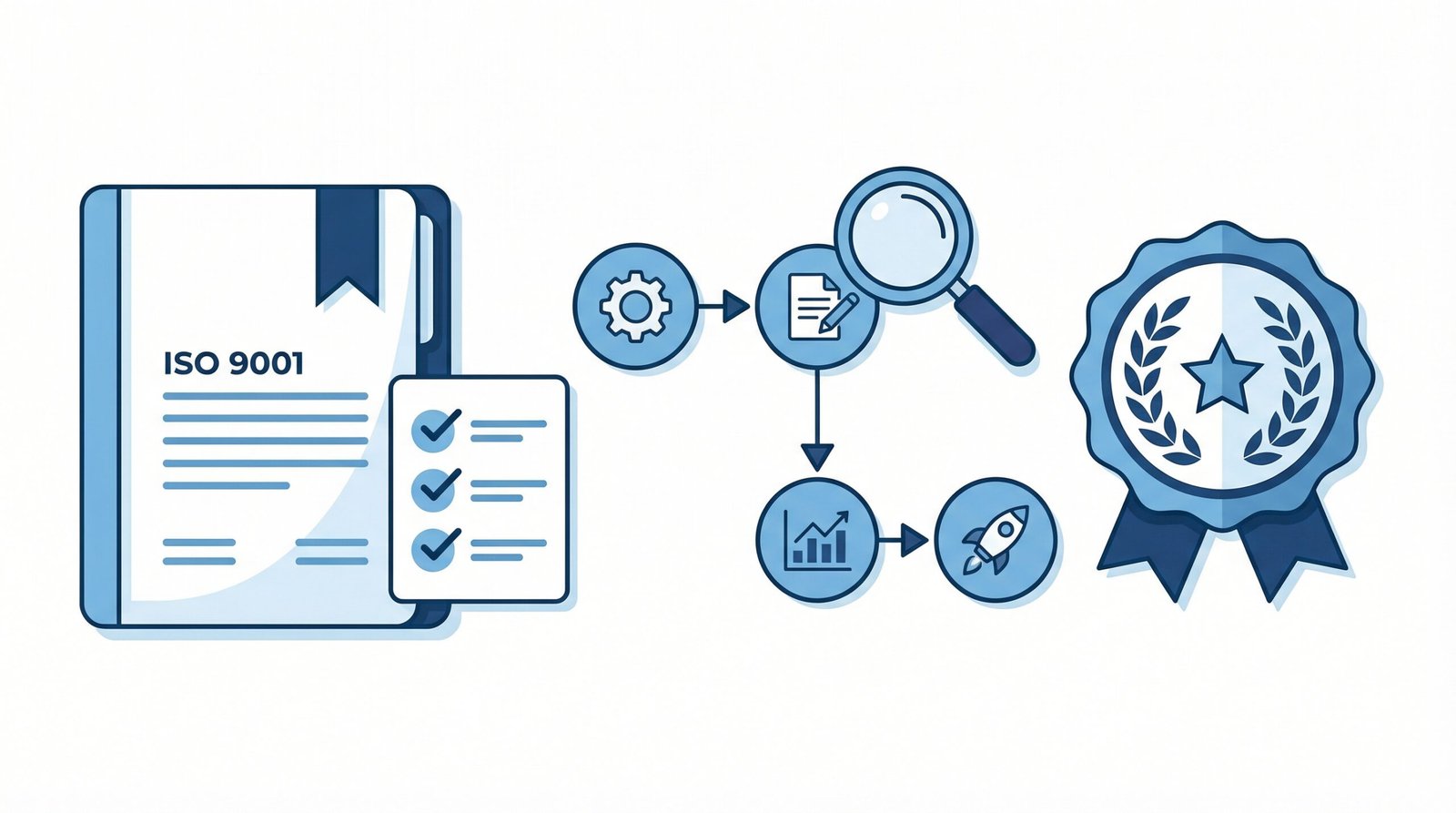
ISO 9001 requirements form the foundation of quality management systems used by over 1.1 million organizations worldwide. Whether you’re pursuing initial certification or maintaining an existing system, understanding every ISO 9001 requirement ensures your quality management system delivers real business value beyond compliance.
This comprehensive guide breaks down all ISO 9001 requirements clause by clause, explaining what each one means in practical terms and how to implement it effectively. We go beyond simply listing ISO 9001 requirements to explain why each one matters and what auditors actually look for during certification assessments.
By the end of this guide, you’ll understand every ISO 9001 requirement clearly enough to lead implementation in your organization or prepare confidently for your next certification audit.
ISO 9001 Requirements Overview
ISO 9001:2015 contains requirements organized across 10 clauses. Clauses 1-3 cover scope, normative references, and terms. The auditable ISO 9001 requirements begin at Clause 4.
The standard follows the High-Level Structure (HLS) making it easier to integrate with other management system standards like ISO 14001 and ISO 45001.
Structure at a Glance
| Clause | Title | Core ISO 9001 Requirement |
|---|---|---|
| 4 | Context of the Organization | Understand your business environment and define QMS scope |
| 5 | Leadership | Top management commitment and quality policy |
| 6 | Planning | Address risks, set objectives, plan changes |
| 7 | Support | Provide resources, ensure competence, control documents |
| 8 | Operation | Plan and control product/service delivery |
| 9 | Performance Evaluation | Monitor, measure, audit, and review |
| 10 | Improvement | Fix problems and continuously improve |
Clause 4: Context of the Organization
These ISO 9001 requirements ensure your quality system fits your specific business situation rather than following a generic template.
4.1 Understanding the Organization and Its Context
What this ISO 9001 requirement means: You must identify external and internal factors that affect your ability to deliver quality products and services.
External issues include:
- Economic conditions affecting your market
- Regulatory changes in your industry
- Competitive landscape and market trends
- Technology developments impacting your processes
- Supply chain risks and dependencies
Internal issues include:
- Organizational culture and values
- Available resources and capabilities
- Knowledge and expertise within the organization
- Current performance levels and known weaknesses
What auditors look for: Evidence that you’ve actually analyzed your context and used it to shape your QMS. A SWOT analysis or PESTLE analysis documented and reviewed regularly satisfies this requirement.
4.2 Understanding Needs and Expectations of Interested Parties
What this ISO 9001 requirement means: Identify who affects or is affected by your quality system and what they need from you.
Key interested parties:
- Customers: Product quality, delivery, price, support
- Employees: Safe working conditions, training, clear expectations
- Suppliers: Clear requirements, timely payment, fair treatment
- Regulators: Legal compliance, reporting, licensing
- Shareholders: Profitability, growth, risk management
What auditors look for: A documented list of interested parties and their relevant requirements. This doesn’t need to be complex but must be current and reviewed periodically.
4.3 Determining the Scope of the QMS
What this ISO 9001 requirement means: Define the boundaries of your quality management system clearly.
Your scope must state:
- Products and services covered
- Locations included
- Any clauses excluded with justification
Important rule: You can only exclude ISO 9001 requirements from Clause 8 (Operation), and only if they genuinely don’t apply to your organization. For example, a service company might exclude 8.3 (Design and Development) if they don’t design anything.
What auditors look for: A clear, documented scope statement available to anyone who needs it. Any exclusions must have solid justification.
4.4 Quality Management System and Its Processes
What this ISO 9001 requirement means: Identify all processes needed for your QMS and understand how they interact.
For each process you must determine:
- Inputs required and outputs expected
- Sequence and interaction with other processes
- Criteria and methods for effective operation
- Resources needed
- Responsibilities and authorities
- Risks and opportunities
- How to monitor and measure performance
What auditors look for: A process map or interaction diagram showing how your processes connect. Each process should have a defined owner accountable for performance.
Clause 5: Leadership
These ISO 9001 requirements place responsibility firmly on top management. Leadership cannot delegate quality to the quality department alone.
5.1 Leadership and Commitment
What this ISO 9001 requirement means: Top management must actively demonstrate commitment to quality, not just sign policies.
5.1.1 General — Top management must:
- Take accountability for QMS effectiveness
- Ensure quality policy and objectives are established
- Integrate quality into business processes
- Promote process approach and risk-based thinking
- Ensure adequate resources are available
- Communicate the importance of effective quality management
- Support other managers in demonstrating leadership
5.1.2 Customer Focus — Top management must ensure:
- Customer requirements are determined and met
- Risks affecting product conformity are addressed
- Focus on enhancing customer satisfaction is maintained
What auditors look for: Evidence of personal involvement, not just signatures. Auditors interview top management and ask specific questions about quality performance, customer feedback, and improvement priorities.
5.2 Quality Policy
What this ISO 9001 requirement means: Create a quality policy that drives your organization’s quality direction.
The policy must:
- Be appropriate to your organization’s purpose
- Include commitment to meet requirements
- Include commitment to continual improvement
- Provide framework for setting quality objectives
- Be communicated and understood throughout the organization
- Be available to interested parties when appropriate
What auditors look for: A policy that is specific to your organization, not generic. They’ll ask random employees what the quality policy means to their daily work.
5.3 Organizational Roles, Responsibilities and Authorities
What this ISO 9001 requirement means: Everyone must know their quality responsibilities.
Top management must assign responsibility for:
- Ensuring QMS conforms to ISO 9001 requirements
- Ensuring processes deliver intended outputs
- Reporting on QMS performance and improvement opportunities
- Promoting customer focus throughout the organization
- Maintaining QMS integrity during changes
What auditors look for: Organizational chart, job descriptions, or responsibility matrices showing clear quality roles. They verify through interviews that people understand their responsibilities.
Clause 6: Planning
These ISO 9001 requirements ensure organizations think ahead rather than just react to problems.
6.1 Actions to Address Risks and Opportunities
What this ISO 9001 requirement means: Identify what could go wrong (risks) and what could go right (opportunities) and plan actions accordingly.
Key points:
- Consider context (4.1) and interested parties (4.2) when identifying risks
- Plan actions to address significant risks and opportunities
- Integrate actions into QMS processes
- Evaluate effectiveness of actions taken
Important: ISO 9001 requirements do NOT mandate a formal risk management framework or risk register. However, most organizations find a simple risk register helpful for demonstrating compliance.
What auditors look for: Evidence of risk-based thinking in decision-making. This can be formal or informal but must be demonstrable.
6.2 Quality Objectives
What this ISO 9001 requirement means: Set measurable quality goals at relevant functions and levels.
Objectives must be:
- Consistent with quality policy
- Measurable where practical
- Relevant to product conformity and customer satisfaction
- Monitored and communicated
- Updated as needed
Plans must include: What will be done, resources needed, who’s responsible, timeline, and how results will be evaluated.
What auditors look for: SMART objectives (Specific, Measurable, Achievable, Relevant, Time-bound) with evidence of regular monitoring and management review.
6.3 Planning of Changes
What this ISO 9001 requirement means: When you change your QMS, do it in a planned manner.
Consider:
- Purpose of the change and potential consequences
- QMS integrity during and after the change
- Resource availability for implementation
- Reallocation of responsibilities if needed
What auditors look for: Evidence that significant changes were planned rather than reactive. Meeting minutes, change requests, or management approvals demonstrate compliance.
Clause 7: Support
These ISO 9001 requirements cover the resources, competencies, and infrastructure needed for your quality system to function.
7.1 Resources
7.1.1 General: Determine and provide resources needed for QMS. Consider existing capabilities and what must come from external providers.
7.1.2 People: Provide sufficient competent personnel for QMS operation.
7.1.3 Infrastructure: Provide and maintain buildings, equipment, utilities, IT systems, and transportation needed for conforming products and services.
7.1.4 Environment: Provide suitable working environment. Consider temperature, humidity, lighting, cleanliness, noise, and psychological factors like stress reduction.
7.1.5 Monitoring and Measuring Resources: Ensure measurement equipment is suitable, maintained, and calibrated when traceability is required. Retain calibration records.
7.1.6 Organizational Knowledge: Determine knowledge needed for processes and product conformity. Maintain this knowledge and make it available. Address changing knowledge needs.
What auditors look for: Calibration records are the most commonly checked evidence. Missing or expired calibrations are among the top ISO 9001 audit findings.
7.2 Competence
What this ISO 9001 requirement means: People doing quality-affecting work must be competent based on education, training, or experience.
You must:
- Determine competence requirements for each role
- Ensure people meet those requirements
- Take action to close competence gaps (training, mentoring, reassignment)
- Evaluate effectiveness of actions taken
- Retain evidence of competence
What auditors look for: Training records, competency matrices, and evidence that training effectiveness was evaluated. “We trained them” isn’t enough — “We verified they can do it correctly” is required.
7.3 Awareness
What this ISO 9001 requirement means: Everyone must understand how their work contributes to quality.
People must be aware of:
- Quality policy
- Relevant quality objectives
- Their contribution to QMS effectiveness
- Consequences of not conforming to requirements
What auditors look for: Random employee interviews asking about quality policy, objectives, and their role. If employees can’t articulate this, it’s a finding.
7.4 Communication
What this ISO 9001 requirement means: Define internal and external communications relevant to quality.
Determine: What to communicate, when, with whom, how, and who does it.
7.5 Documented Information
What this ISO 9001 requirement means: Control your quality documents and records.
Creating documents: Proper identification, format, review, and approval.
Controlling documents: Availability, protection, distribution, storage, retention, and change control.
What auditors look for: Obsolete documents removed from use, current versions available where needed, and changes properly tracked. Document control failures are the most common ISO 9001 audit finding.
For ready-to-use document templates, explore our free quality management templates.
Clause 8: Operation
Clause 8 contains the most extensive ISO 9001 requirements, covering how you actually deliver products and services.
8.1 Operational Planning and Control
What this ISO 9001 requirement means: Plan how you’ll deliver products and services meeting requirements.
You must:
- Determine product/service requirements
- Establish acceptance criteria
- Determine resources needed
- Implement process controls
- Retain evidence of conformity
- Control planned changes and review unintended changes
- Control outsourced processes
8.2 Requirements for Products and Services
8.2.1 Customer Communication: Communicate with customers about products, contracts, inquiries, feedback, complaints, and contingency actions.
8.2.2 Determining Requirements: Define all requirements including regulatory ones and any requirements you consider necessary.
8.2.3 Review of Requirements: Review requirements before committing to supply. Resolve any differences between stated and previously expressed requirements.
What auditors look for: Contract review records showing you verified ability to meet requirements before accepting orders.
8.3 Design and Development
What this ISO 9001 requirement means: If you design products or services, control the design process systematically.
Key ISO 9001 requirements for design:
- 8.3.2 Planning: Define design stages, reviews, verification, and validation activities
- 8.3.3 Inputs: Identify functional requirements, regulatory requirements, and standards
- 8.3.4 Controls: Conduct design reviews, verification, and validation at planned stages
- 8.3.5 Outputs: Ensure outputs meet inputs, reference acceptance criteria, and identify critical characteristics
- 8.3.6 Changes: Identify, review, and control design changes
What auditors look for: Complete design records showing inputs traced to outputs through verification and validation. Missing design reviews are a common finding.
Medical device companies face additional design control ISO 9001 requirements under ISO 13485.
8.4 Control of Externally Provided Processes, Products and Services
What this ISO 9001 requirement means: Control what you get from suppliers.
You must:
- Determine controls based on impact on your product quality
- Evaluate, select, monitor, and re-evaluate suppliers
- Define requirements clearly to suppliers
- Verify externally provided products meet your requirements
What auditors look for: Approved supplier list, evaluation records, incoming inspection results, and evidence of periodic re-evaluation.
8.5 Production and Service Provision
8.5.1 Control: Implement production under controlled conditions including documented information, monitoring resources, competent personnel, and validated processes.
Error prevention actions in this clause connect directly to Poka Yoke error-proofing techniques for preventing defects at the source.
8.5.2 Identification and Traceability: Identify outputs and their monitoring status throughout production. Control unique identification when traceability is required.
8.5.3 Customer Property: Care for property belonging to customers or external providers. Report any loss or damage.
8.5.4 Preservation: Preserve outputs during production including handling, packaging, storage, and protection.
8.5.5 Post-Delivery: Meet requirements for activities after delivery including warranty, maintenance, and recycling.
8.5.6 Control of Changes: Review and control production changes. Retain records of change results and authorizing persons.
8.6 Release of Products and Services
What this ISO 9001 requirement means: Verify products and services meet requirements at appropriate stages before delivery.
What auditors look for: Release records showing who authorized release and evidence that planned verification was completed.
8.7 Control of Nonconforming Outputs
What this ISO 9001 requirement means: Identify and control products that don’t meet requirements to prevent unintended delivery.
Actions include: Correction, segregation, containment, return to supplier, customer notification, or concession authorization.
What auditors look for: Nonconformance records, disposition decisions, and evidence that corrected products were re-verified.
Clause 9: Performance Evaluation
These ISO 9001 requirements ensure you monitor, measure, and evaluate your quality system’s effectiveness.
9.1 Monitoring, Measurement, Analysis and Evaluation
9.1.1 General: Determine what to monitor and measure, methods to use, when to perform monitoring, and when to analyze results.
Effective process monitoring uses statistical process control charts to distinguish normal variation from signals requiring action.
9.1.2 Customer Satisfaction: Monitor customer perceptions of how well you meet their needs. Determine methods for obtaining and using this information.
9.1.3 Analysis and Evaluation: Analyze data to evaluate product conformity, customer satisfaction, QMS performance, planning effectiveness, risk actions, supplier performance, and improvement needs.
For statistical analysis methods supporting these ISO 9001 requirements, see our statistical quality control resources.
9.2 Internal Audit
What this ISO 9001 requirement means: Conduct planned internal audits verifying your QMS works as intended.
You must:
- Plan audit program considering process importance and previous results
- Define audit criteria, scope, frequency, and methods
- Select auditors ensuring objectivity and impartiality
- Report results to relevant management
- Take corrections and corrective actions without undue delay
- Retain evidence of the audit program and results
What auditors look for: A complete audit cycle covering all processes annually. Auditor independence from the area being audited. Follow-up on findings showing effective closure.
Use our free ISO 9001 audit checklist for comprehensive internal audit coverage.
9.3 Management Review
What this ISO 9001 requirement means: Top management must periodically review the QMS to ensure it remains suitable, adequate, and effective.
Required inputs:
- Status of actions from previous reviews
- Changes in external and internal issues
- QMS performance data (customer satisfaction, objectives, process performance, nonconformities, audit results, supplier performance, resource adequacy)
- Effectiveness of risk and opportunity actions
- Improvement opportunities
Required outputs:
- Improvement decisions and actions
- QMS changes needed
- Resource needs identified
What auditors look for: Management review minutes showing all required inputs were discussed and specific decisions/actions were recorded with owners and deadlines.
Clause 10: Improvement
These final ISO 9001 requirements drive continuous improvement throughout your organization.
10.1 General
What this ISO 9001 requirement means: Determine and select improvement opportunities. Implement actions to meet customer requirements and enhance satisfaction.
10.2 Nonconformity and Corrective Action
What this ISO 9001 requirement means: When things go wrong, fix them and prevent recurrence.
When nonconformity occurs you must:
- React to control and correct it
- Evaluate need for action to eliminate the cause
- Determine root causes through investigation
- Implement corrective actions
- Review corrective action effectiveness
- Update risks and opportunities if necessary
- Make QMS changes if needed
What auditors look for: CAPA records showing thorough root cause analysis, not just surface-level fixes. “Retrain the operator” without addressing why the error was possible usually gets challenged.
Effective corrective action connects to Total Quality Management principles of systematic problem-solving and continuous improvement culture.
10.3 Continual Improvement
What this ISO 9001 requirement means: Continuously improve QMS suitability, adequacy, and effectiveness using analysis results and management review outputs.
What auditors look for: Evidence of genuine improvement over time, not just maintaining the status quo. Trend data showing measurable progress toward quality objectives demonstrates compliance.
Most Common ISO 9001 Audit Findings
Understanding which ISO 9001 requirements generate the most findings helps you focus preparation efforts.
| Rank | ISO 9001 Requirement | Common Finding | Prevention |
|---|---|---|---|
| 1 | 7.5 Document Control | Obsolete documents in use | Regular document reviews and purges |
| 2 | 7.1.5 Calibration | Overdue or missing calibrations | Automated calibration tracking system |
| 3 | 10.2 Corrective Action | Weak root cause analysis | Train in 5-Why and Fishbone methods |
| 4 | 8.4 Supplier Control | No re-evaluation evidence | Annual supplier scorecard reviews |
| 5 | 7.2 Competence | Missing training records | Centralized training management system |
| 6 | 6.1 Risk | Generic risk register never updated | Integrate risk into process management |
| 7 | 9.2 Internal Audit | Auditor not independent | Cross-department audit assignments |
| 8 | 9.3 Management Review | Missing required inputs | Use standardized agenda template |
ISO 9001 Requirements vs ISO 13485 Requirements
Organizations in regulated industries often need to understand how ISO 9001 requirements compare with industry-specific standards.
| Requirement Area | ISO 9001 | ISO 13485 |
|---|---|---|
| Risk Management | Risk-based thinking (general) | Formal ISO 14971 risk management |
| Design Control | If applicable | Mandatory with extensive documentation |
| Improvement | Continual improvement required | Compliance maintenance focus |
| Validation | When output cannot be verified | Required for all production processes |
| Traceability | When required | Mandatory for all devices |
For medical device specific requirements, see our comprehensive ISO 13485 guide.
How to Implement ISO 9001 Requirements
Follow this proven implementation roadmap to address all ISO 9001 requirements systematically.
Phase 1: Gap Analysis (2-4 weeks)
- Assess current practices against every ISO 9001 requirement
- Score compliance level for each clause
- Identify critical gaps requiring immediate attention
- Develop prioritized action plan with timeline
Phase 2: Documentation (2-3 months)
- Write quality policy and objectives
- Create quality manual (recommended but not required)
- Develop required procedures and work instructions
- Design forms and templates for quality records
Phase 3: Implementation (3-4 months)
- Train all personnel on relevant procedures
- Execute processes generating quality records
- Conduct internal audits verifying implementation
- Hold management reviews evaluating effectiveness
Phase 4: Certification (1-2 months)
- Stage 1 audit: Documentation review
- Address any Stage 1 findings
- Stage 2 audit: Implementation assessment
- Close any nonconformances
- Receive certificate (valid 3 years)
ISO 9001 Certification Costs
| Company Size | Implementation | Certification Body | Total |
|---|---|---|---|
| Small (1-25) | $5,000-$15,000 | $3,000-$8,000 | $8,000-$23,000 |
| Medium (26-100) | $15,000-$30,000 | $8,000-$15,000 | $23,000-$45,000 |
| Large (100+) | $30,000-$75,000 | $15,000-$30,000 | $45,000-$105,000 |
Recommended Resources
Essential Books
- “ISO 9001:2015 in Plain English” by Craig Cochran — Clear clause-by-clause explanation perfect for implementation teams
- “The ISO 9001:2015 Implementation Handbook” by Milton P. Dentch — Step-by-step implementation guide
- “How to Audit the Process-Based QMS” by Dennis R. Arter — Essential for internal auditors
Quality Management Software
Managing ISO 9001 requirements efficiently requires appropriate tools. Our quality management software comparison reviews 15 platforms helping organizations automate compliance.
Six Sigma Integration
ISO 9001 requirements for continual improvement work best when combined with structured improvement methodologies. Our Six Sigma books guide covers resources for building analytical improvement capability.
Conclusion: Mastering ISO 9001 Requirements
ISO 9001 requirements provide a comprehensive framework for building quality management systems that deliver real business results. Every requirement exists for a practical reason: ensuring customer satisfaction, preventing problems, and driving continuous improvement.
The organizations that benefit most from ISO 9001 requirements are those that implement the spirit of each clause, not just the letter. A quality system built on genuine commitment to quality excellence outperforms one built merely to pass audits.
Start with a thorough gap analysis against these ISO 9001 requirements. Prioritize the areas where your organization has the biggest gaps. Implement systematically, train your team thoroughly, and maintain discipline through regular audits and management reviews.
The investment in understanding and implementing ISO 9001 requirements pays dividends through improved customer satisfaction, operational efficiency, and competitive advantage that compounds over years of disciplined application.
Ready to implement ISO 9001 requirements? Start with our free clause-by-clause ISO 9001 checklist to assess your current compliance level and build your implementation roadmap.