
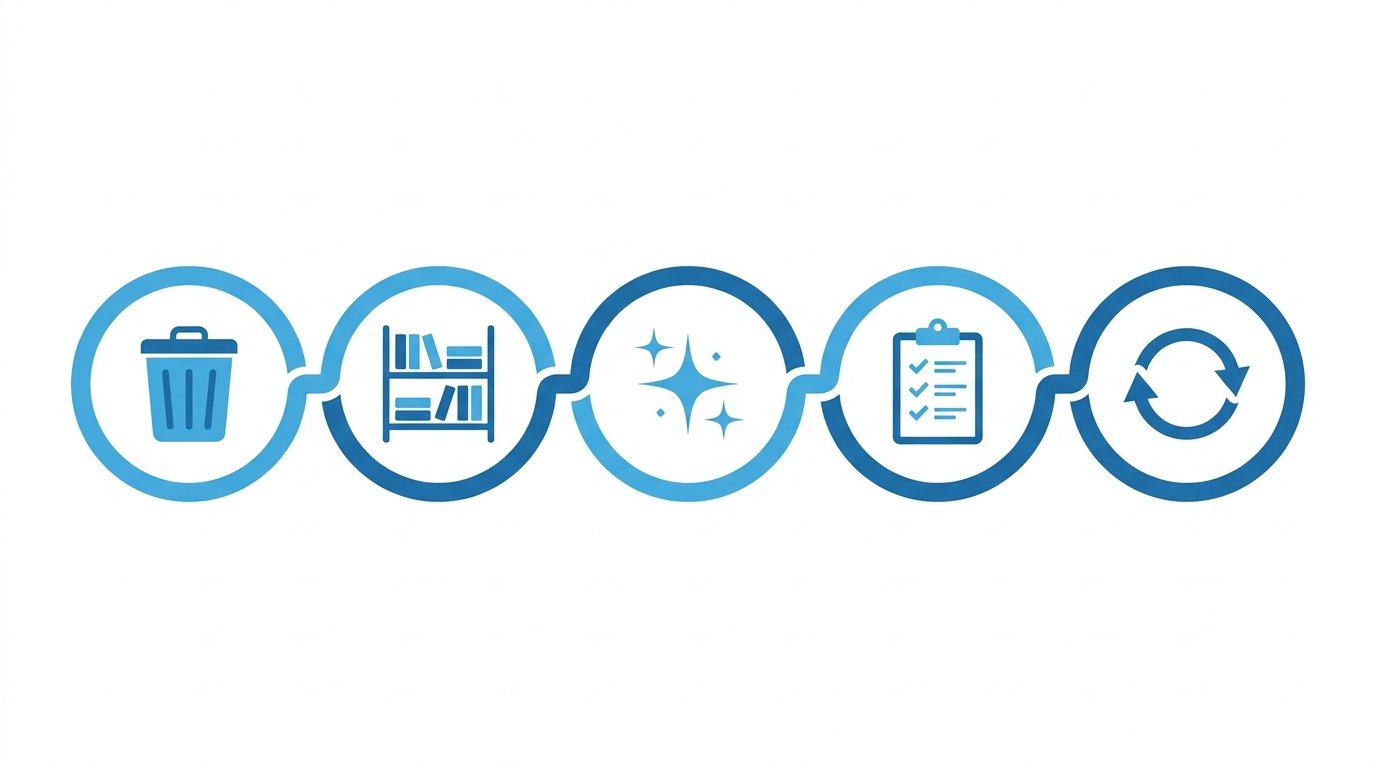
5S methodology is the foundation of lean manufacturing and workplace organization. Developed within the Toyota Production System, 5S transforms chaotic work environments into efficient, safe, and productive spaces through five systematic steps. Organizations implementing 5S methodology consistently report 10-30% productivity gains, significant safety improvements, and dramatic reductions in wasted time searching for tools and materials.
This complete guide explains every step of 5S methodology with real-world examples, implementation templates, and proven strategies for sustaining results long-term. Whether you’re launching 5S methodology in a manufacturing plant, office, warehouse, or healthcare facility, these practical insights ensure successful implementation.
Understanding 5S methodology is essential for any quality professional. It creates the organized, standardized foundation that makes advanced improvement methodologies like Six Sigma and Total Quality Management far more effective.
What is 5S Methodology?
5S methodology is a systematic approach to workplace organization using five Japanese principles. Each “S” represents one step in creating and maintaining an organized, efficient workspace.
| Step | Japanese | English | Core Action |
|---|---|---|---|
| 1S | Seiri | Sort | Remove unnecessary items |
| 2S | Seiton | Set in Order | Organize remaining items |
| 3S | Seiso | Shine | Clean everything thoroughly |
| 4S | Seiketsu | Standardize | Create standards to maintain |
| 5S | Shitsuke | Sustain | Build discipline and habits |
5S methodology originated within the Toyota Production System as documented by the Lean Enterprise Institute as a foundational practice enabling all other lean improvements. Without organized workplaces, advanced techniques like just-in-time production and error-proofing cannot function effectively.
Why 5S Methodology Matters
Many organizations dismiss 5S methodology as “just cleaning.” This fundamentally misunderstands its purpose and power.
5S methodology actually delivers:
- Productivity Gains: Workers spend 5-15% of their time searching for tools and information. 5S methodology eliminates this waste.
- Safety Improvements: Organized workplaces have 40-60% fewer accidents. Clutter causes trips, falls, and injuries.
- Quality Enhancement: Clean, organized environments make defects visible immediately. Contamination and mix-ups decrease dramatically.
- Employee Morale: People take pride in organized workplaces. Engagement increases when the environment shows respect for workers.
- Foundation for Improvement: Every lean and quality methodology works better in a 5S environment. It’s the prerequisite for excellence.
Step 1: Sort (Seiri) — Remove the Unnecessary
The first step of 5S methodology eliminates everything not needed for current operations. Most workplaces accumulate surprising amounts of unnecessary items over time.
How to Implement Sort
The Red Tag Process:
- Provide red tags to every team member in the target area
- Tag every item whose necessity is questionable
- Move tagged items to a designated “red tag holding area”
- Set evaluation period (typically 30 days)
- Items not claimed or used within the period are disposed of
Sort Decision Criteria
| Frequency of Use | Action | Location |
|---|---|---|
| Used every hour | Keep at workstation | Within arm’s reach |
| Used daily | Keep in work area | Within walking distance |
| Used weekly | Keep in department | Nearby storage |
| Used monthly | Keep in facility | Central storage |
| Used less than yearly | Consider disposing | Archive or discard |
| Never used | Dispose immediately | Recycle, sell, or trash |
Real-World Sort Example
Manufacturing Plant: A machining department sorted their tool cribs and discovered 40% of stored tooling hadn’t been used in over two years. Removing these items freed 12 storage cabinets and reduced tool search time by 60%.
Office Environment: An accounting department sorted file cabinets and found 30% of documents were duplicates and 25% were outdated. Eliminating these freed three entire filing cabinets and reduced document retrieval time from 5 minutes to 30 seconds.
Common Sort Mistakes
- Keeping “just in case” items: If you haven’t used it in a year, you probably won’t need it
- Not involving the team: Workers know best what’s needed and what’s not
- Skipping the red tag period: Immediate disposal creates resistance and mistakes
Step 2: Set in Order (Seiton) — A Place for Everything
The second step of 5S methodology organizes remaining items so anyone can find and return them quickly. The goal: any person should locate any item within 30 seconds.
How to Implement Set in Order
- Analyze workflow: Observe how people move and what they reach for most often
- Assign locations: Place frequently used items closest to point of use
- Create visual indicators: Labels, color-coding, floor markings, shadow boards
- Implement “first in, first out” for consumables
- Document layouts with photos and diagrams
Key Set in Order Techniques
Shadow Boards: Outlined shapes showing exactly where each tool belongs. Missing tools are immediately visible.
Floor Markings: Tape or paint marking designated locations for equipment, carts, bins, and walkways.
Color Coding: Assign colors to departments, product lines, or tool types for instant visual identification.
Labeling: Clear labels on shelves, bins, drawers, and containers identifying contents and quantities.
Kanban Signals: Visual indicators showing when to reorder supplies before they run out.
Real-World Set in Order Examples
Surgical Operating Room: Every instrument has a designated position on the surgical tray. Setup time reduced from 45 minutes to 15 minutes. Missing instruments detected immediately before surgery begins.
Warehouse: Implemented labeled locations with barcode scanning. Pick accuracy improved from 96% to 99.8%. New employees reached full productivity in 2 days instead of 2 weeks.
These visual management techniques connect directly to Poka Yoke error-proofing principles by making the correct action obvious and incorrect actions difficult.
Common Set in Order Mistakes
- Organizing without observing workflow first: The most logical layout follows actual work patterns
- Insufficient labeling: If a visitor can’t find items, your labeling isn’t good enough
- Ignoring ergonomics: Heavy items should be at waist height, not floor or overhead
Step 3: Shine (Seiso) — Clean and Inspect
The third step of 5S methodology goes beyond cleaning. Shine means restoring the workplace to like-new condition while using cleaning as an opportunity to inspect for problems.
How to Implement Shine
- Initial deep clean: Clean everything thoroughly including areas normally ignored
- Identify contamination sources: Find where dirt, oil, debris originate
- Eliminate root causes: Fix leaks, install guards, add covers
- Create cleaning schedules: Assign daily, weekly, and monthly cleaning tasks
- Combine cleaning with inspection: Train workers to spot abnormalities while cleaning
Shine as Inspection
This is the critical insight most organizations miss about 5S methodology. Cleaning isn’t the goal — inspection is.
When operators clean their equipment daily, they notice:
- Oil leaks indicating seal failures
- Unusual vibrations suggesting bearing wear
- Loose bolts before they cause breakdowns
- Worn hoses before they burst
- Cracks before they become failures
This transforms operators into the first line of defense against equipment failure. Japanese manufacturers call this “autonomous maintenance.”
Real-World Shine Example
Food Processing Plant: Implemented daily 15-minute shine routines. Within 3 months, unplanned downtime decreased 35% because operators caught problems early during cleaning inspections.
Hospital: Daily shine routines in patient care areas reduced hospital-acquired infection rates by 25% while simultaneously identifying maintenance issues (loose handrails, damaged flooring) before they caused patient injuries.
Common Shine Mistakes
- Treating cleaning as janitorial work: Operators must clean their own areas to develop ownership
- Not addressing contamination sources: Cleaning symptoms without fixing causes wastes effort
- Skipping the inspection component: Cleaning without looking for problems misses the real value
Step 4: Standardize (Seiketsu) — Make It the Norm
The fourth step of 5S methodology creates standards that maintain the improvements from the first three steps. Without standardization, workplaces inevitably return to their original state.
How to Implement Standardize
- Document standards: Create simple, visual standards for Sort, Set in Order, and Shine
- Photograph ideal conditions: “Before” and “standard” photos at each workstation
- Create checklists: Daily, weekly, and monthly 5S task lists
- Assign responsibilities: Every area has an owner accountable for maintaining standards
- Schedule audits: Regular 5S audits verify standards are maintained
5S Audit Checklist
| Category | Audit Question | Score (1-5) |
|---|---|---|
| Sort | Are only necessary items present? | |
| Sort | Are red-tagged items resolved within timeframe? | |
| Set in Order | Can any item be found within 30 seconds? | |
| Set in Order | Are all locations clearly labeled? | |
| Shine | Is the area clean and free of debris? | |
| Shine | Are cleaning schedules followed? | |
| Standardize | Are visual standards posted and current? | |
| Standardize | Do all shifts maintain the same standards? | |
| Sustain | Are audits conducted on schedule? | |
| Sustain | Are improvement actions completed? |
Standardization Tools
- Visual Standards Photos: Pictures showing exactly how each area should look
- One-Point Lessons: Single-page visual instructions for specific tasks
- Color-Coded Schedules: Red/yellow/green calendars showing cleaning assignments
- Digital Checklists: Tablet-based audit forms with photo documentation
Common Standardize Mistakes
- Over-documenting: Simple visual standards work better than lengthy procedures
- Not involving workers in creating standards: People follow standards they helped create
- Different standards per shift: All shifts must maintain identical standards
Step 5: Sustain (Shitsuke) — Build the Habit
The fifth and most challenging step of 5S methodology transforms organized workplaces from a project into a permanent culture. Most 5S methodology implementations fail at this step.
How to Implement Sustain
- Leadership commitment: Managers must visibly participate in 5S methodology activities
- Regular audits: Weekly or monthly scored audits with results posted publicly
- Recognition programs: Acknowledge and reward teams maintaining excellent 5S
- Training new employees: Include 5S methodology in onboarding from day one
- Continuous improvement: Regularly update and improve standards
Sustain Strategies That Work
5S Patrol: Rotating team of employees from different departments conducting weekly audits. Cross-department exposure shares best practices.
5S Competition: Monthly scoring with friendly competition between departments. Post results on visual management boards. Celebrate winners.
Management Gemba Walks: Leaders regularly walk the floor specifically observing 5S conditions. Their attention signals organizational importance.
5S Minutes: Dedicated 5-10 minutes at shift start or end for 5S maintenance activities. Built into the schedule, not squeezed in.
Why 5S Methodology Fails
| Failure Reason | Percentage | Prevention |
|---|---|---|
| Management loses interest | 35% | Include 5S in leadership KPIs |
| No audit system | 25% | Scheduled audits with accountability |
| Treated as one-time event | 20% | Embed in daily routines |
| No recognition | 10% | Celebrate and reward consistently |
| Insufficient training | 10% | Ongoing training and coaching |
6S: Adding Safety
Many organizations extend 5S methodology to 6S by adding Safety as either the first or sixth step.
Safety Integration
- During Sort: Remove hazardous materials and expired chemicals
- During Set in Order: Mark emergency exits, extinguisher locations, and hazardous areas
- During Shine: Identify safety hazards like frayed cords, damaged guards, slippery floors
- During Standardize: Include safety checks in audit checklists
- During Sustain: Track safety metrics alongside 5S scores
Adding safety reinforces that 5S methodology serves worker wellbeing, not just productivity. This increases employee buy-in significantly.
5S Methodology in Different Environments
Manufacturing
Focus Areas:
- Tool cribs and shadow boards at each workstation
- Raw material storage with FIFO management
- Machine cleanliness and autonomous maintenance
- Floor markings for material flow and safety zones
- Visual work instructions at point of use
Typical Results: 20-30% reduction in setup time, 40% reduction in searching time, 50% fewer safety incidents.
Office Environment
Focus Areas:
- Desktop organization (physical and digital)
- File management and document control
- Shared space organization (kitchens, meeting rooms, printers)
- Email inbox management
- Supply closet organization
Typical Results: 15-25% reduction in document search time, improved meeting room availability, reduced supply costs.
Healthcare
Focus Areas:
- Medication storage and organization
- Supply rooms with visual kanban systems
- Equipment standardized locations across units
- Patient room standardization
- Emergency cart organization and verification
Typical Results: 30% reduction in supply costs, faster emergency response, reduced medication errors.
Healthcare organizations implementing quality systems like ISO 13485 find that 5S methodology creates the organized foundation essential for regulatory compliance.
Warehouse and Logistics
Focus Areas:
- Bin labeling and location management
- Receiving and shipping area organization
- Equipment staging and charging stations
- Aisle marking and traffic flow
- Returns processing area
Typical Results: 25% improvement in pick accuracy, 30% reduction in shipping errors, faster order fulfillment.
5S Methodology Implementation Timeline
| Phase | Duration | Activities |
|---|---|---|
| Preparation | 1-2 weeks | Training, area selection, team formation, before photos |
| Sort Event | 1-2 days | Red tagging, removal of unnecessary items |
| Set in Order | 2-3 days | Reorganize layout, create labels, install visual controls |
| Shine | 1-2 days | Deep clean, identify contamination sources, create schedules |
| Standardize | 1 week | Document standards, create audit checklists, photograph ideal state |
| Sustain Setup | 1 week | Launch audit program, establish recognition system |
| Ongoing | Permanent | Daily maintenance, weekly audits, monthly reviews |
5S Methodology ROI
Investing in 5S methodology delivers measurable financial returns.
| Benefit Category | Typical Improvement | Annual Savings Example |
|---|---|---|
| Reduced search time | 40-60% reduction | $25,000-$100,000 |
| Fewer accidents | 40-60% reduction | $10,000-$50,000 |
| Less equipment downtime | 20-35% reduction | $50,000-$200,000 |
| Reduced defects | 10-25% reduction | $20,000-$100,000 |
| Space savings | 15-30% freed | $10,000-$75,000 |
| Inventory reduction | 10-20% reduction | $15,000-$50,000 |
5S Methodology and Quality Standards
The American Society for Quality (ASQ) recognizes 5S methodology as a foundational lean practice supporting multiple quality standards.
5S methodology supports compliance with major quality standards.
ISO 9001 Connection
ISO 9001 requirements for infrastructure (7.1.3), work environment (7.1.4), and preservation (8.5.4) are directly supported by effective 5S methodology implementation.
ISO 13485 Connection
Medical device manufacturers need controlled environments for production. 5S methodology provides the foundation for cleanroom discipline and contamination control.
IATF 16949 Connection
Automotive quality standards require organized workplaces supporting lean manufacturing. 5S methodology is often the first assessment item during customer audits.
5S Methodology Tools and Supplies
Essential supplies for launching 5S methodology:
- Red Tags: Pre-printed tags for Sort phase identification
- Label Maker: For creating durable, professional labels
- Floor Tape: Color-coded tape for area marking (yellow for walkways, red for safety)
- Shadow Board Materials: Foam or painted boards with tool outlines
- Cleaning Supplies: Quality cleaning materials for Shine phase
- Camera: For before/after documentation and visual standards
- Audit Forms: Printed or digital checklists for regular assessments
Recommended 5S Methodology Books
- “5S for Operators” by Productivity Press — Simple, visual guide perfect for shop floor training
- “5 Pillars of the Visual Workplace” by Hiroyuki Hirano — Comprehensive 5S methodology reference from Japanese manufacturing expert
- “The 5S Playbook” by Chris Ortiz — Practical step-by-step implementation guide with templates
For the lean manufacturing foundations behind 5S methodology, explore our Shigeo Shingo books guide covering the Toyota Production System principles. For statistical tools that complement 5S improvements, see our statistical quality control books collection.
Integrating 5S Methodology with Other Improvements
5S methodology works best as a foundation for broader improvement initiatives.
5S + Six Sigma
Organized workplaces produce more reliable data for Six Sigma analysis. Implement 5S methodology first, then launch DMAIC projects with confidence in data quality.
5S + Control Charts
Clean, standardized processes produce more stable control chart data. 5S methodology reduces special cause variation from environmental factors.
5S + Poka Yoke
5S methodology’s visual management principles connect directly to error-proofing. Shadow boards and color-coding prevent wrong-tool and wrong-part errors.
5S + Quality Management Software
Digital quality management software platforms support 5S with mobile audit apps, photo documentation, and corrective action tracking.
Conclusion: Start Your 5S Methodology Journey
5S methodology is the simplest yet most impactful improvement you can make in any workplace. It requires no statistical expertise, no expensive software, and no lengthy training programs.
What 5S methodology does require is commitment. Commitment from leadership to support and participate. Commitment from teams to maintain standards daily. Commitment to seeing organization not as a project but as a permanent way of working.
Start with one pilot area. Follow the five steps systematically. Document before and after results. Then expand 5S methodology to adjacent areas based on proven success.
The organizations that excel at 5S methodology share one trait: they view it not as cleaning but as the foundation of operational excellence. Build that foundation and every subsequent improvement initiative becomes easier, faster, and more sustainable.
Ready to launch 5S methodology in your organization? Begin with one pilot area, follow the five steps in this guide, and measure results. Combine 5S methodology with our ISO 9001 implementation checklist for a comprehensive quality foundation that drives lasting improvement.