
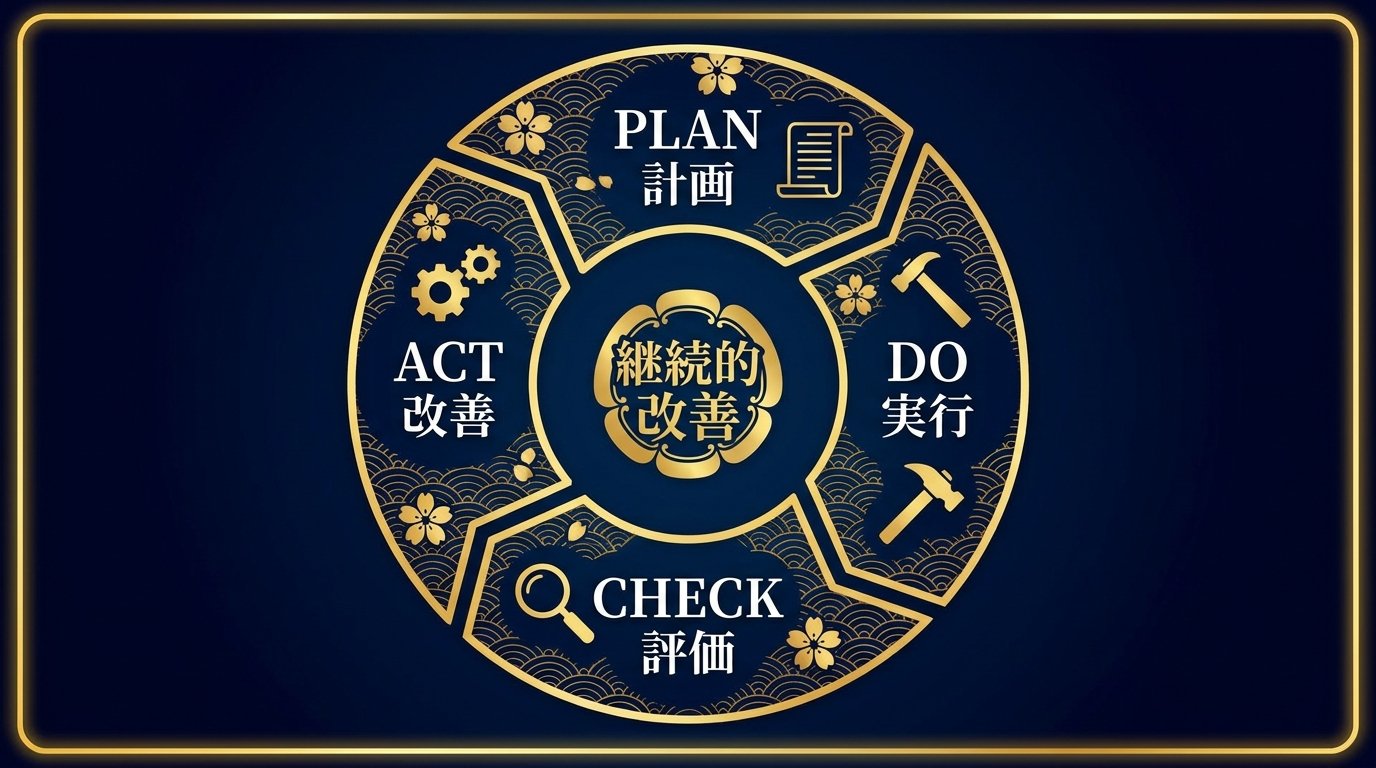
What is Kaizen?
Kaizen (改善) is a Japanese philosophy meaning “change for the better” or “continuous improvement.” It is a systematic approach to identifying and eliminating waste through small, incremental improvements made consistently over time — involving every employee at every level of the organization.
The term combines two Japanese words:
- Kai (改) = Change
- Zen (善) = Good / Better
Unlike dramatic business transformations that require large budgets and long timelines, kaizen focuses on making small improvements every single day — creating a compound effect that delivers extraordinary results over time.
“Small improvements are better than postponed perfection.” — Kaizen philosophy
The History of Kaizen
Kaizen originated in Japan after World War II, heavily influenced by American quality experts W. Edwards Deming and Joseph Juran, who taught statistical quality control methods to Japanese manufacturers.
Key milestones in kaizen history:
- 1950s: Toyota develops the Toyota Production System (TPS), incorporating kaizen as a core principle
- 1986: Masaaki Imai publishes Kaizen: The Key to Japan’s Competitive Success, introducing the concept to the Western world
- 1990s: Western manufacturers adopt kaizen as part of lean manufacturing programs
- 2000s–present: Kaizen expands beyond manufacturing into healthcare, software development, banking, and services
5 Core Kaizen Principles
Kaizen is built on five fundamental principles that guide every improvement activity:
1. Know Your Customer
Every process exists to deliver value to a customer — internal or external. Kaizen starts by understanding what customers truly value and eliminating everything that does not contribute to that value.
2. Let It Flow
Work should flow smoothly without interruptions, delays, or bottlenecks. Kaizen identifies and removes obstacles that disrupt the natural flow of work through a process.
3. Go to Gemba
Gemba (現場) means “the real place” — where work actually happens. Kaizen practitioners go directly to the shop floor, hospital ward, or service desk to observe problems firsthand, rather than relying on reports or assumptions.
4. Empower People
The people doing the work know it best. Kaizen empowers frontline employees to identify problems and suggest improvements — not just managers or engineers.
5. Be Transparent
Problems must be visible to be solved. Kaizen encourages open communication, visual management, and honest reporting of issues without fear of blame.
The Kaizen Cycle: PDCA
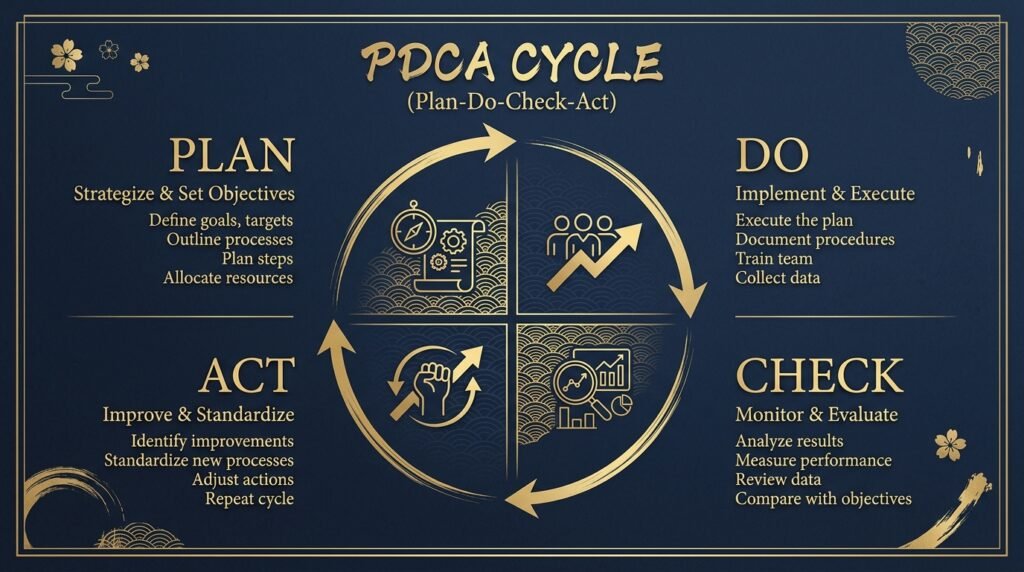
Kaizen improvements follow the PDCA cycle (Plan-Do-Check-Act), also known as the Deming Cycle:
| Phase | Action |
|---|---|
| Plan | Identify the problem, analyze root causes, develop an improvement plan |
| Do | Implement the improvement on a small scale as a test |
| Check | Measure results and compare against expected outcomes |
| Act | Standardize the improvement if successful, or adjust and repeat |
The PDCA cycle never stops — each completed cycle feeds into the next, creating a continuous spiral of improvement.
5 Types of Kaizen
1. Point Kaizen
The most common type — small, spontaneous improvements made immediately when a problem is spotted. No formal process required. Example: A worker notices tools are disorganized and rearranges them for faster access.
2. System Kaizen
Planned improvements targeting an entire system or process, organized by management. Example: Redesigning the entire order fulfillment process to reduce delivery time by 30%.
3. Line Kaizen
Improvements that flow from one process to connected upstream or downstream processes. Example: Improving a machining station also triggers improvements at the inspection and assembly stations linked to it.
4. Plane Kaizen
Improvements across multiple lines or departments simultaneously. Example: Implementing standardized quality checks across all production lines in a factory.
5. Cube Kaizen
Organization-wide transformation where improvements at every level connect and reinforce each other. Example: A company-wide lean transformation program affecting every department from production to finance.
Kaizen Events (Kaizen Blitz): How They Work
A kaizen event — also called a kaizen blitz or rapid improvement event — is an intensive, focused improvement effort completed in 3–5 days.
Day-by-Day Kaizen Event Schedule
Day 1: Define & Observe
- Select the target process
- Walk the gemba and observe the current state
- Map the value stream
- Define the measurable improvement goal
Day 2: Analyze
- Identify waste and root causes
- Use fishbone diagrams and 5 Whys analysis
- Brainstorm improvement ideas
- Prioritize solutions by impact and effort
Days 3–4: Implement
- Make physical changes to the workspace
- Update procedures and work instructions
- Train employees on new methods
- Test and refine the improved process
Day 5: Sustain
- Measure results against baseline metrics
- Document the new standard
- Present findings to leadership
- Create a 30-day follow-up plan
When to Use a Kaizen Event
- When a process has clear, persistent problems
- When quick, visible results are needed to build momentum
- When cross-functional teamwork is required
- When you need to demonstrate the power of kaizen to skeptical stakeholders
Essential Kaizen Tools and Techniques
5S Methodology
A workplace organization system that creates a clean, efficient, and standardized environment. The five steps — Sort, Set in Order, Shine, Standardize, Sustain — provide the foundation for all kaizen activities by making problems immediately visible.
👉 Read our complete guide: 5S Methodology Step-by-Step Implementation Guide
5 Whys Analysis
A root cause analysis technique that asks “Why?” five times to uncover the true cause of a problem, rather than treating symptoms.
Example:
- Problem: Machine stopped working
- Why 1: Overloaded and fused
- Why 2: Insufficient lubrication
- Why 3: Oil pump not circulating enough
- Why 4: Pump intake clogged with metal chips
- Why 5: No filter installed on the pump ← Root cause
Value Stream Mapping (VSM)
A visual tool that maps the complete flow of materials and information through a process to identify waste and target improvement opportunities with maximum impact.
Fishbone Diagram (Ishikawa)
A cause-and-effect diagram that organizes potential causes of a problem into six categories: Man, Machine, Method, Material, Measurement, and Environment (the 6Ms).
Poka-Yoke (Error Proofing)
Devices or methods that prevent mistakes from occurring — or make them immediately obvious when they do. Poka-yoke is one of the most powerful kaizen tools for eliminating defects permanently.
👉 Read our complete guide: 50+ Poka Yoke Examples: Error-Proofing Guide
Kanban
A visual scheduling system that controls inventory and work-in-progress using cards or signals to trigger production only when needed — eliminating overproduction waste.
Control Charts
Statistical process control charts that track process performance over time, making it easy to distinguish between normal variation and special causes that require corrective action.
👉 Read our complete guide: Control Charts: Types, Examples & Interpretation
Kaizen vs. Other Improvement Methodologies
| Feature | Kaizen | Six Sigma | Business Process Reengineering |
|---|---|---|---|
| Approach | Small, continuous improvements | Data-driven defect reduction | Radical process redesign |
| Speed | Immediate | Months to years | Months to years |
| Scope | Any process, any size | High-impact processes | Entire processes |
| Who leads | All employees | Trained specialists | Senior management |
| Risk | Low | Medium | High |
| Cost | Low | Medium to high | High |
| Best for | Daily operations | Complex quality problems | Outdated processes |
Key insight: Kaizen and Six Sigma are complementary, not competing. Many organizations use both — kaizen for daily improvements and Six Sigma for complex, data-intensive problems.
👉 Learn more: What is Six Sigma? Complete Beginner’s Guide
Real-World Kaizen Examples
Kaizen in Manufacturing: Toyota
Toyota’s Georgetown, Kentucky plant uses kaizen to generate over 1 million improvement suggestions per year from its workforce — with more than 90% implemented. This continuous flow of small improvements has made Toyota consistently one of the most productive and highest-quality automakers in the world, serving as the model for lean manufacturing globally.
Kaizen in Healthcare: Virginia Mason Medical Center
Virginia Mason Medical Center in Seattle applied Toyota Production System principles — including kaizen — to patient care processes. Results included a 53% reduction in the distance nurses walked per shift, an 85% reduction in inventory costs in some departments, and measurable improvements in patient safety outcomes.
Kaizen in Logistics: Amazon
Amazon uses kaizen principles throughout its fulfillment centers, continuously optimizing picking routes, packaging workflows, and inventory placement. Small, incremental improvements across millions of daily operations translate into massive cumulative efficiency gains.
Kaizen in Software: Agile Development
The agile software development methodology borrows heavily from kaizen. Daily standups, sprint retrospectives, and continuous deployment are expressions of the core kaizen principle: make small, frequent improvements based on real feedback.
How to Implement Kaizen in Your Organization: 7 Steps
Step 1: Secure Leadership Commitment
Kaizen cannot succeed without visible, sustained commitment from top management. Leaders must model kaizen behavior — visiting the gemba regularly, participating in events, and responding positively to employee suggestions.
Step 2: Train Your Entire Team
Provide basic kaizen training to all employees, covering what kaizen means, how to identify the 8 wastes, how to use basic tools (5S, 5 Whys, PDCA), and how to submit and implement improvement ideas effectively.
Step 3: Build an Improvement Suggestion System
Create a simple, accessible system for capturing improvement ideas: suggestion boxes (physical or digital), standing improvement agenda items in team meetings, and a tracking system that shows employees their ideas are heard and acted upon.
Step 4: Start with 5S
5S creates the organized, standardized environment that makes problems immediately visible — the prerequisite for all kaizen activity. It is the most effective starting point for any improvement program.
👉 Read: 5S Methodology: Complete Implementation Guide
Step 5: Run Your First Kaizen Event
Select a process with visible problems and clear improvement potential. Run a focused 3–5 day kaizen event to deliver concrete results, build team confidence, and demonstrate the power of the methodology to the entire organization.
Step 6: Standardize Every Improvement
Every improvement must be standardized — documented in updated work instructions, visual controls, and training materials — so gains are locked in and not lost when people change roles or leave the organization.
Step 7: Measure, Review, and Celebrate
Track key metrics before and after each improvement cycle. Hold regular review sessions to assess progress. Celebrate successes at every level — recognition is the fuel that sustains a kaizen culture long-term.
The 8 Wastes Kaizen Eliminates (DOWNTIME)
Kaizen systematically targets the 8 wastes of lean manufacturing, remembered with the acronym DOWNTIME:
| Waste | Description | Manufacturing Example |
|---|---|---|
| Defects | Products or services that don’t meet requirements | Rework, scrap, warranty claims |
| Overproduction | Producing more than is needed right now | Excess inventory filling warehouse space |
| Waiting | Idle time while waiting for materials, approvals, or equipment | Operators waiting for machine setup |
| Non-utilized talent | Underusing employee skills, ideas, and knowledge | Ignoring frontline improvement suggestions |
| Transportation | Unnecessary movement of materials | Moving parts across the factory multiple times |
| Inventory | Excess materials or work-in-progress beyond immediate need | Raw material stockpiles tying up capital |
| Motion | Unnecessary movement of people | Workers walking long distances to find tools |
| Extra processing | Doing more work than the customer requires | Over-engineering parts beyond specification |
6 Common Kaizen Mistakes to Avoid
1. Starting Without Management Buy-In
Without visible leadership commitment, kaizen initiatives quickly lose momentum. If managers don’t visibly support and participate in improvements, employees conclude that it isn’t truly important.
2. Waiting for Big Ideas
The power of kaizen lies in small, daily improvements. Organizations that wait for breakthrough ideas miss thousands of small improvements that compound into major competitive advantages over time.
3. Skipping Standardization
Without standardizing improvements in updated work instructions and visual controls, processes drift back to old habits within weeks. Standardization is what converts a one-time improvement into a permanent gain.
4. Blaming People Instead of Processes
Kaizen improves systems — not punishes people. A blame culture destroys the psychological safety that employees need to honestly report problems and suggest improvements.
5. Running Events Without Follow-Up
A kaizen event is the beginning of an improvement, not the end. Without follow-up audits at 30, 60, and 90 days, the gains from even the most successful events tend to erode.
6. Excluding Frontline Employees
The people doing the work have the most detailed, accurate knowledge of where the real problems are. Organizations that design improvements without frontline input consistently underperform those that actively engage all employees.
Kaizen Metrics: How to Measure Your Program’s Success
| Metric | What It Measures |
|---|---|
| Number of suggestions submitted | Employee engagement and participation level |
| Suggestion implementation rate | Management responsiveness to employee ideas |
| Cycle time reduction (%) | Process efficiency improvement |
| Defect rate reduction (%) | Quality improvement over time |
| Cost savings per improvement | Financial impact of the program |
| Employee participation rate (%) | Depth of kaizen culture adoption |
Best Kaizen Books Worth Reading
Build a deep understanding of kaizen with these essential resources:
- Kaizen: The Key to Japan’s Competitive Success by Masaaki Imai — the original kaizen text that introduced the concept to the Western world
- The Toyota Way by Jeffrey Liker — the 14 management principles behind Toyota’s extraordinary success
- Gemba Kaizen by Masaaki Imai — practical kaizen implementation at the workplace level
- 2-Second Lean by Paul Akers — an accessible, practical introduction to daily kaizen for any organization
👉 See our full list: 20 Best Six Sigma and Lean Books for Practitioners
Frequently Asked Questions About Kaizen
What does kaizen mean in English?
Kaizen is a Japanese word that translates to “change for the better” or “continuous improvement.” It combines kai (change) and zen (good).
Is kaizen only for manufacturing?
No. While kaizen originated in manufacturing at Toyota, it is now widely applied in healthcare, software development, logistics, financial services, education, and any field where processes can be improved.
How is kaizen different from Six Sigma?
Kaizen focuses on small, continuous improvements made by all employees. Six Sigma uses statistical analysis to eliminate defects in complex processes, led by trained specialists. The two approaches work extremely well together — kaizen for everyday improvements, Six Sigma for data-intensive quality problems.
How long does it take to implement kaizen?
Individual improvements can be implemented immediately. Building a genuine kaizen culture — where continuous improvement becomes part of everyday work — typically takes 2–3 years of consistent effort and visible leadership commitment.
What is a kaizen blitz?
A kaizen blitz (also called a kaizen event or rapid improvement event) is an intensive 3–5 day improvement effort focused on a specific process. It brings together a cross-functional team to analyze, improve, standardize, and sustain a process change rapidly.
What is the difference between kaizen and lean manufacturing?
Lean manufacturing is a comprehensive system for eliminating waste and maximizing value — kaizen is one of its core practices. Lean provides the framework and goals; kaizen provides the day-to-day mechanism for continuous improvement within that framework.
Conclusion
Kaizen is more than a management tool — it is a mindset that fundamentally transforms how organizations think about improvement. By making small, consistent improvements every day, involving every employee at every level, and relentlessly eliminating waste, kaizen creates a sustainable competitive advantage that is genuinely difficult for competitors to replicate.
The organizations that benefit most from kaizen are not the ones with the largest budgets or the most sophisticated systems — they are the ones that start, persist, and never stop improving.
Pick one process. Find one problem. Make one improvement today.
That is kaizen.
Continue learning with our related guides: