
What is Root Cause Analysis?
Root Cause Analysis (RCA) is a systematic problem-solving method used to identify the fundamental, underlying cause of a problem — rather than simply treating its visible symptoms. The goal of RCA is to find why a problem happened so that a permanent solution can prevent it from ever recurring.
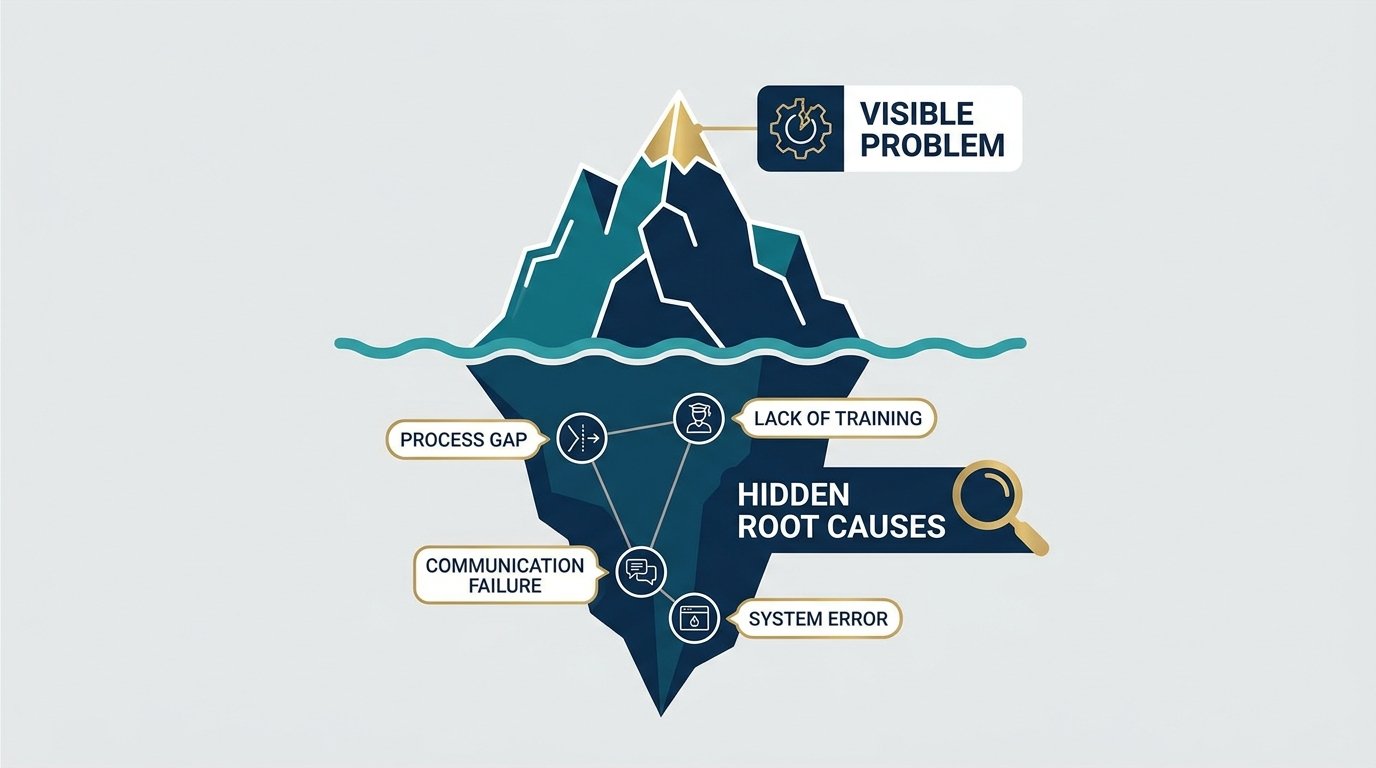
The core principle is simple: most problems are like an iceberg. The visible symptom is only the small part above the surface, while the real cause lies hidden underneath. According to the American Society for Quality (ASQ), effective RCA focuses on correcting the root cause rather than reacting to each symptom as it appears.
RCA is a cornerstone of quality management, used across manufacturing, healthcare, IT, aviation, and virtually every industry where preventing problem recurrence is critical.
“If you treat the symptom, the problem returns. If you treat the root cause, the problem disappears.”
Why Root Cause Analysis Matters
Without RCA, organizations fall into a costly cycle of fixing the same problems over and over. The benefits of a disciplined root cause analysis process include:
- Permanent problem resolution — fixing causes, not symptoms, stops recurrence
- Cost reduction — fewer repeated failures means lower rework, scrap, and warranty costs
- Improved quality — systematically eliminating defect sources raises overall quality
- Better decision-making — data-driven analysis replaces guesswork and blame
- Regulatory compliance — RCA is required for CAPA (Corrective and Preventive Action) in ISO 9001, ISO 13485, and FDA-regulated industries
👉 Related: Free ISO 9001 Checklist: Complete Audit & Implementation Guide
The History of Root Cause Analysis
The roots of RCA trace back to Sakichi Toyoda, founder of Toyota Industries, who developed the 5 Whys technique in the early 20th century. The method became a foundational part of the Toyota Production System and later spread worldwide through lean manufacturing and Six Sigma.
Today, root cause analysis has expanded far beyond manufacturing into healthcare (preventing medical errors), aviation (accident investigation), IT (incident management), and occupational safety (accident prevention).
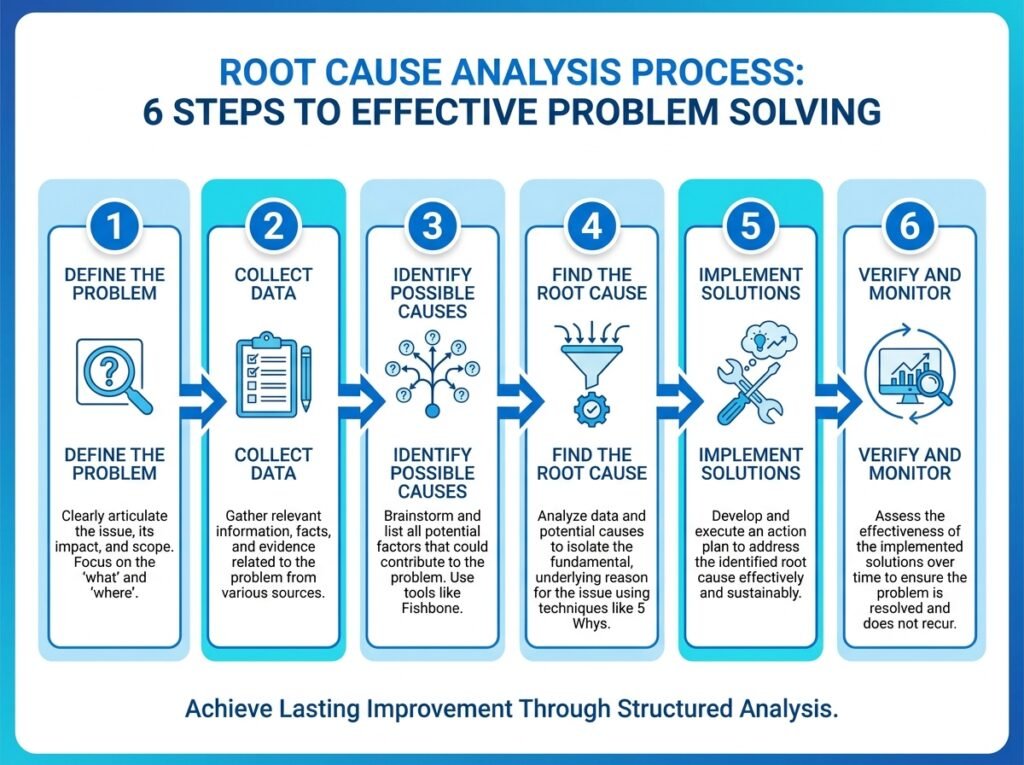
The Root Cause Analysis Process: 6 Steps
A structured RCA follows six clear steps from problem identification to verified solution:
Step 1: Define the Problem
Clearly describe what is happening, when, where, and how often. A precise, fact-based problem statement is the foundation of effective analysis. Avoid vague statements like “quality is poor” — instead use “12% of units fail final inspection due to surface defects.”
Step 2: Collect Data
Gather objective evidence about the problem: measurements, records, photos, and observations. Go to the gemba — the actual place where the problem occurs — to see conditions firsthand.
Step 3: Identify Possible Causes
Brainstorm all potential causes using tools like the Fishbone diagram. Consider every category — people, machines, methods, materials, measurement, and environment.
Step 4: Identify the Root Cause
Drill down past the symptoms to the true underlying cause using the 5 Whys and data analysis. A genuine root cause is one that, when corrected, prevents the problem from recurring.
Step 5: Implement Solutions
Develop and apply corrective actions that address the root cause directly. Update procedures, add error-proofing, and train affected employees.
Step 6: Verify and Monitor
Confirm the solution actually worked by measuring results over time. Monitor the process to ensure the problem does not return, and standardize the fix so the gain is permanent.
Top 5 Root Cause Analysis Tools and Techniques
Quality professionals rely on a proven toolkit of RCA methods. Here are the five most important — with real examples of each.
1. The 5 Whys
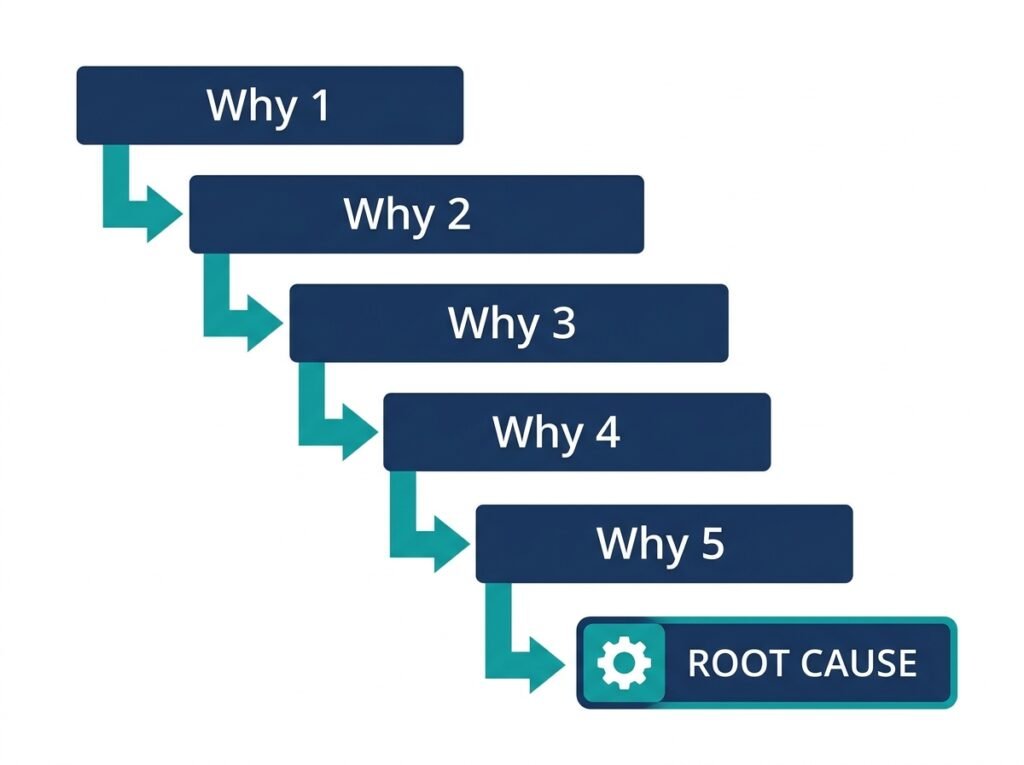
The 5 Whys is the simplest and most widely used RCA technique. You start with the problem and ask “Why did this happen?” repeatedly — usually five times — until you reach the root cause. It works best for problems with a single, dominant cause.
Real Example:
- Problem: The machine stopped working
- Why 1? The circuit overloaded and the fuse blew
- Why 2? The bearing was not lubricated enough
- Why 3? The oil pump was not circulating enough oil
- Why 4? The pump intake was clogged with metal chips
- Why 5? There was no filter on the pump intake ← Root Cause
The fix: Installing a filter (and a maintenance schedule to clean it) permanently prevents the failure — far more effective than simply replacing the fuse.
2. Fishbone Diagram (Ishikawa)
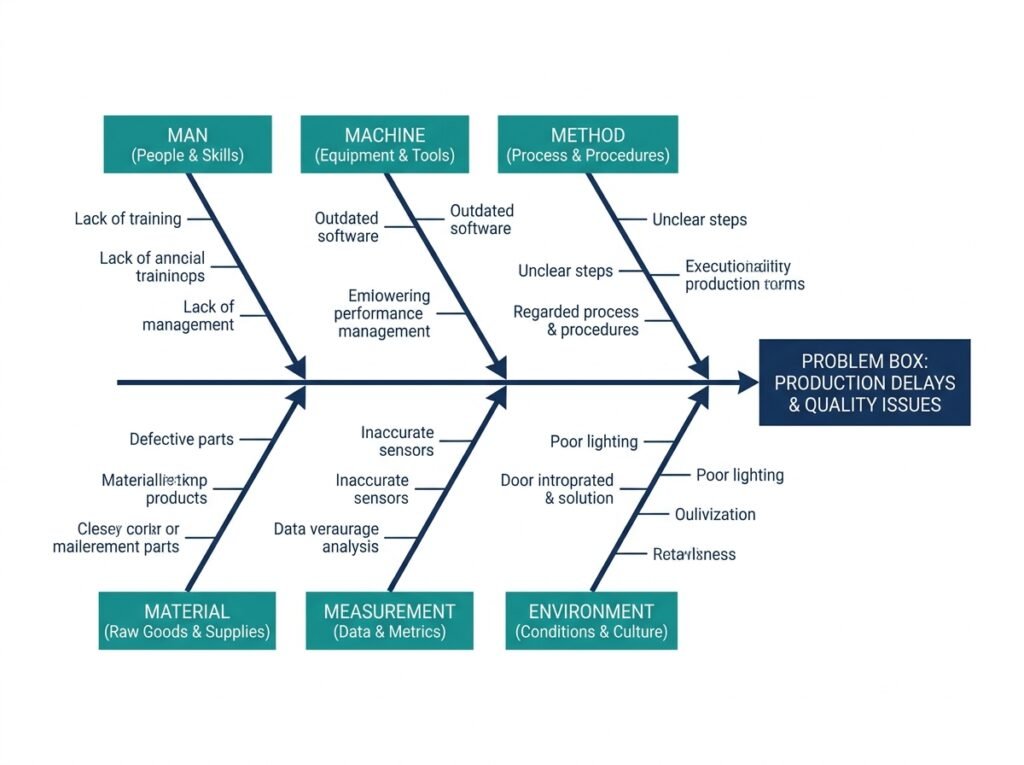
The Fishbone diagram — also called the Ishikawa or cause-and-effect diagram — visually organizes potential causes into categories. The classic manufacturing categories are the 6Ms:
- Man — people, skills, training
- Machine — equipment, tools, technology
- Method — procedures, processes, instructions
- Material — raw materials, components, supplies
- Measurement — inspection, data, calibration
- Environment — workplace conditions, temperature, layout
The Fishbone diagram is ideal for complex problems with multiple possible causes, helping teams brainstorm systematically rather than jumping to conclusions.
3. Pareto Analysis
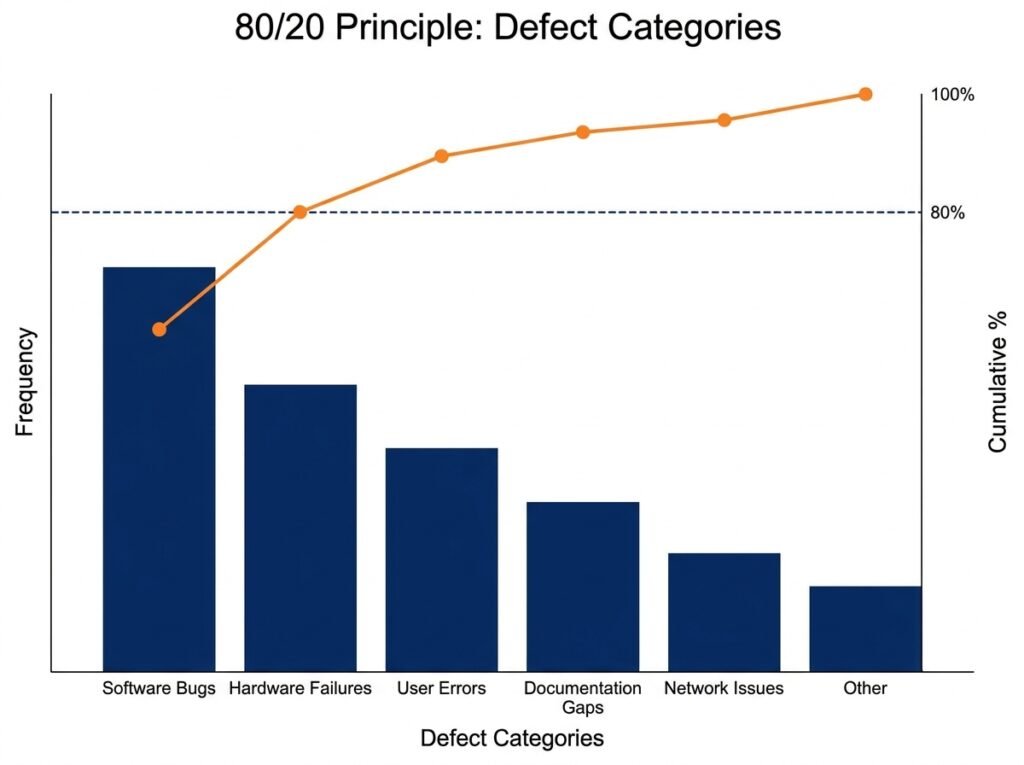
Pareto analysis applies the 80/20 rule: roughly 80% of problems come from 20% of causes. A Pareto chart ranks causes by frequency or impact, helping teams focus their effort where it matters most.
Real Example: A service desk analyzes 500 customer complaints and discovers that just two error types account for 80% of all complaints. By fixing those two issues first, the team eliminates the majority of complaints with minimal effort.
4. FMEA (Failure Mode and Effects Analysis)
FMEA is a proactive RCA tool that identifies potential failure modes before they happen, ranks them by risk, and prioritizes preventive action. Unlike the other tools, FMEA looks forward to prevent problems rather than backward to explain them.
FMEA is essential in industries where failures carry high consequences — automotive, aerospace, and medical devices.
5. Fault Tree Analysis (FTA)
Fault Tree Analysis is a top-down, logical diagram that starts with an undesired event and works backward through all the possible combinations of causes that could lead to it. It uses logic gates (AND/OR) and is widely used in safety-critical systems and reliability engineering.
Root Cause Analysis Tools Comparison
| Tool | Best For | Complexity | Direction |
|---|---|---|---|
| 5 Whys | Simple problems with one main cause | Low | Backward (reactive) |
| Fishbone | Complex problems, team brainstorming | Medium | Backward (reactive) |
| Pareto | Prioritizing among many causes | Low | Backward (reactive) |
| FMEA | Preventing high-risk failures | High | Forward (proactive) |
| Fault Tree | Safety-critical and complex systems | High | Backward (reactive) |
Root Cause Analysis Example: Step by Step
Here is a complete RCA walkthrough for a common manufacturing problem.
Problem: A bottling line is producing bottles with leaking caps — 8% of units fail the seal test.
Step 1 – Define: 8% of bottles fail the seal test at final inspection, concentrated on the night shift.
Step 2 – Collect Data: Failures spike between 2 AM and 5 AM. The capping torque readings are lower during those hours.
Step 3 – Identify Possible Causes (Fishbone): Machine wear, operator error, material variation, temperature changes.
Step 4 – Find Root Cause (5 Whys):
- Why are caps leaking? → Capping torque is too low
- Why is torque too low? → The torque setting drifts during the shift
- Why does it drift? → The machine is not recalibrated overnight
- Why isn’t it recalibrated? → No calibration check is scheduled for the night shift
- Why is there no schedule? → The maintenance procedure only covers the day shift ← Root Cause
Step 5 – Implement Solution: Add a mandatory torque calibration check at the start of every shift, including nights. Apply poka-yoke (a torque sensor that stops the line if readings drift).
Step 6 – Verify: After implementation, seal-test failures drop from 8% to 0.3% and stay there. The root cause is confirmed eliminated.
👉 Related: 50+ Poka Yoke Examples: Complete Error-Proofing Guide
Root Cause Analysis in Quality Management Systems
RCA is not optional in formal quality systems — it is a mandatory requirement. In ISO 9001 and ISO 13485, every nonconformity must trigger a Corrective and Preventive Action (CAPA) process, and CAPA requires documented root cause analysis.
RCA also connects directly to other quality methodologies:
- Six Sigma — the “Analyze” phase of DMAIC is essentially structured root cause analysis
- Kaizen — continuous improvement relies on RCA to eliminate the source of recurring waste
- Statistical Process Control — control charts signal when a special cause needs root cause investigation
👉 Related: What is Six Sigma? Complete Beginner’s Guide
👉 Related: Kaizen: Complete Guide to Continuous Improvement
👉 Related: Control Charts: Types, Examples & Interpretation
Common Root Cause Analysis Mistakes to Avoid
1. Stopping at Symptoms
The most common mistake is treating the first cause you find as the root cause. If correcting it doesn’t prevent recurrence, you stopped too early. Keep asking “why.”
2. Blaming People Instead of Processes
“Operator error” is almost never a true root cause. Ask why the error was possible — usually the real cause is a process or system that allowed the mistake to happen.
3. Jumping to Solutions
Teams often rush to fix things before fully understanding the cause. This wastes resources on solutions that don’t address the real problem.
4. Relying on Opinions Instead of Data
Effective RCA is evidence-based. Assumptions and guesses lead to wrong conclusions — always verify with measurable data.
5. Skipping Verification
Implementing a fix is not the end. Without verifying that the problem actually stopped, you can’t know if you found the real root cause.
6. Not Standardizing the Fix
If the corrective action isn’t documented and built into standard procedures, the problem will slowly return as people revert to old habits.
Free Root Cause Analysis Template
A simple RCA report should capture the following elements:
| Section | What to Document |
|---|---|
| Problem Statement | What happened, when, where, and how often |
| Team Members | Who participated in the analysis |
| Data Collected | Evidence, measurements, observations |
| Analysis Method | 5 Whys, Fishbone, Pareto, etc. |
| Root Cause | The verified underlying cause |
| Corrective Actions | Specific actions, owners, and deadlines |
| Verification | How and when the fix was confirmed effective |
👉 Related: Free ISO 13485 Templates: Download Essential QMS Documents
Best Books on Root Cause Analysis
Deepen your RCA skills with these trusted references:
- Root Cause Analysis: The Core of Problem Solving and Corrective Action by Duke Okes — the definitive practical guide for quality professionals
- The Quality Toolbox by Nancy Tague — a comprehensive reference covering RCA and dozens of quality tools
- Apollo Root Cause Analysis by Dean Gano — a structured, repeatable RCA methodology
- Understanding Variation by Donald Wheeler — essential for distinguishing common causes from special causes
👉 See more: Best Statistical Quality Control Books Reading List
Frequently Asked Questions About Root Cause Analysis
What is root cause analysis in simple terms?
Root cause analysis is a method for finding the real, underlying reason a problem happened — not just the obvious symptom — so you can fix it permanently and stop it from coming back.
What are the main root cause analysis tools?
The five most common RCA tools are the 5 Whys, the Fishbone (Ishikawa) diagram, Pareto analysis, FMEA, and Fault Tree Analysis. Each suits different types of problems.
What is the difference between 5 Whys and Fishbone?
The 5 Whys is best for simple problems with a single dominant cause, drilling straight down to the root. The Fishbone diagram is better for complex problems with many possible causes, organizing them into categories for systematic brainstorming.
Is root cause analysis the same as corrective action?
No. Root cause analysis identifies why a problem occurred. Corrective action is the step you take to fix the root cause. RCA always comes first — you can’t take effective corrective action without knowing the true cause.
How many “whys” should I ask in the 5 Whys method?
Five is a guideline, not a rule. Ask “why” as many times as needed to reach a cause that, when corrected, prevents the problem from recurring. Sometimes that’s three whys; sometimes it’s seven.
Where is root cause analysis used?
RCA is used in manufacturing, healthcare, IT incident management, aviation safety, occupational safety, and any quality management system following ISO 9001 or ISO 13485.
Conclusion
Root cause analysis is one of the most valuable skills in quality management because it breaks the costly cycle of fixing the same problems again and again. By looking beneath the surface symptom to find and eliminate the true underlying cause, RCA turns recurring headaches into permanent solutions.
Start with the simplest tool — the 5 Whys — on your next problem. Resist the urge to jump to solutions. Keep asking “why” until you reach a cause that, when fixed, makes the problem disappear for good.
That is the power of root cause analysis.
Continue learning with our related guides: